-
Don’t imitate entropy

February 15, 2025 @ 5:11pm – Hawthorn, Victoria Everything you do has a consequence.
“Consequence” might make you think of detention, jail, guilt, regret.
But consequence is as simple as cause and effect.
Are you aware that everything you do has a consequence?
The other day, I took a cardboard box down to the bin area of my apartment building. Instead of crushing it, I tossed it into a corner. We always have reasons for doing things like this. No matter what the action is, we can justify it.
The next few trips to the bins, I saw my box still sitting there. I ignored it.
Then, one day, I saw another box next to it. Now there were two.
Someone copied me.
René Girard says we are imitative beings. We watch each other. We look up. We show off. We mirror. We are born and then we start to watch other people.
Instead of eating the healthiest food or wearing the most appropriate clothes, we copy the habits and style of others, often making our lives more difficult.
We resemble our parents not just because of genetics, but because we watched, listened, and learned from them – a lot.
But even if you don’t have a family to care for or a company to run, you still can’t separate yourself from others.
No matter how unique, reclusive, or separate we feel, a microscope proves there’s no barrier or border containing us.
We can feel deeply responsible for what we have influence over.
I listened to a podcast about a guy who went into a depression because of the troubles his son was facing. Because of something stupid the son did, the father blamed himself and slid into a depression for three years.
This is a natural.
So what do we do?
We could drive ourselves crazy over making sure we only have a positive influence on our surroundings.
But we can’t really know all the ways we will ‘effect’ others. It’s impossible. The variables are too complex.1 Just like you’ll never really know what is ‘effecting’ you.
Take out the recycling, or don’t. But once in a while, I hope a small sign reminds you—somewhere, someone is watching.
Originally published on Substack
-
Don’t die on a hill

January 27, 2025 @ 10:31am – Mt. Donna Buang, Australia Do you know the difference between struggling and suffering?
A hot day on a bike might show you the difference. One moment you’re quietly complaining to yourself about the dwindling water in your bidon and the next moment you’re a martyr.
Historically, a martyr was someone who would volunteer to die rather than renounce their religion. They chose to take a bullet for a belief.
Martyrs don’t take the easy way out:
- Instead of asking for help, they grit their teeth in isolation.
- Instead of trouble shooting they resigns themselves to endless frustration.
- Instead of easing up they doubling down, as if suffering is a good thing.
On a long gravel bike ride with far and few stops for refueling, I caught myself in this martyr frame of mind. I’d been there hundreds of times before without much recognition.
When our group finally pulled up at a 7-11, passive aggression, bitterness and resentment had almost entirely consumed me.
I rushed past my friends to the fridge, burning with righteousness. But before I cracked open my drink, I managed to catch myself.
I asked myself a simple question. This question stops the martyr in its tracks.
What do I need right now?
The false-selflessness, the white knuckling, the relentlessness, the self-destruction all came crashing to a halt.
What do I need?
What do I need? I need to sit down for a few minutes and cool down. That’s it. That’s all. There’s no point to prove. No badge of honor. I simply need to sit down.
I slowly sip my drink and gently tune back into a conversation about the fires in L.A. I finish my drink. My heart rate steadies.
What do I need?
I needed that.
Being a bit of a martyr can fuel us because there’s always someone or something to rail against. It can stroke our ego and make us feel falsely superior and falsely selfless, because the ego is always right.
Martyrdom feels powerful, but problem-solving actually is.
When we let the martyr go and ask ourselves what we need, we come back to neutral reality. We can gain focus on the actual problem to solve. And when we do that, we open ourselves to real, simple solutions. A purple gatorade. Borrowing sunscreen from a friend. A detour. A conversation.
We all have hills to die on. Martyrdom is likely not completely unavoidable for some us (more stubborn) folks. But life is too short to rip ourselves to shreds over a belief.
So next time you find yourself dragging yourself into a personal war,
Just ask:
👉 What do I need?
-
Don’t grind your teeth
July 11 2024 @ 3:32ppm – Yerba Buena, CA I don’t train for races like normal people do.
Normal people sign up for a race for a particular reason, train and prepare and then do their best effort on the day.
I don’t do that.
For some strange reason I avoid research, training plans, coaches. I do my own thing. Instead of calmly and happily sticking to a plan, I grit my teeth and take on an attitude that the world is against me. Sometimes I summon the energy to take on tough physical challenges that raise the eyebrows of others, but don’t really help me get ready.
When I hear about my friends clocking miles on their trainer, I roll my eyes, generally resentful of their progress.
And if I don’t perform like I hoped I would, I heap the blame back on myself. I wasn’t disciplined enough. Not motivated enough. I throw around ultimatums like “I’ll quit cycling forever.”
It’s a mess.
But I’ve been thinking.
I believe something strange.
And this belief is what likely messes with my training, and perhaps every other aspect of my life.
I believe everything has to be hard.
Or put another way…
I believe I have to grit my teeth in order to get to a good result.
I believe that if something is hard, unpleasant and requires a lot of grit teeth, it must be good, or the right thing to do.
I have to admit, I feel morally superior when I grit my teeth.
And I believe if I grit my teeth hard enough, I can control the outcome.
Strange isn’t it.
No one told me to grit my teeth.
Although it gives me a certain kind of energy, it doesn’t feel very pleasant.
And if I’m honest, it rarely helps with whatever I’m trying to do.
It doesn’t make me smarter, faster, funnier, kinder.
It just makes me want grit my teeth more.
Last year when I was bonking, it suddenly became clear that the tooth grinding wasn’t moving my bike forward. It’s a reaction that I’ve told myself is important, rather than a causative force.
Of course my ego didn’t want to hear that. So it came up with all sorts of other excuses, to assure me that I hadn’t lost control.
- I’m not really into this sort of thing anyway.
- Everyone else is obsessive and freakish, and I’m the only normal one.
- I didn’t work hard enough (this time).
It’s all bullshit.
I have a theory that perfectionists are afflicted by this ‘tooth grinding’ disease more so than others. Most people just don’t care that much about being good or perfect. They’re too busy having fun.
The harsh reality for perfectionists is that no one is perfect. No one can make anything perfect. There’s no points handed out the more you suffer, or feel hard done by.
The best one can do is to acknowledge the straining attitude, and if you can bear it – to laugh.
-
Dream symbols of 2024

Sunlight and Shadow Study, 1855, Albert Bierstadt – July 13, 2024 @ 11:10am – De Young Museum, San Francisco Dreams are usually dismissed as “nothing other than very vivid thoughts” with limited benefit to your waking life.
And if you’ve ever taken the time to remember and record your dreams, you’ll probably agree that they don’t make much sense. (Learn how AI can help to decipher your dreams.)
But occasionally you’ll pick up a clear message, a directive or an understanding about someone you care about. So even though I don’t always learn something from dreams, I like to think of them as educational. The fact that they might need to repeat themselves lots of times for the message to sink in is more a comment on my learning style. I’m sure most of my high school teachers would agree.
In 2024, I made a habit of drawing one image or symbol that stood out from my dreams of the night before. Since most dreams are blurry or are about people, they can be hard to draw. So, I biased towards images that were easy to draw. If a dolphin appeared as an element in any of my dreams, I’d draw that the next day. In most cases this would only be one symbol. If there was a few, I’d pick the more interesting one, or one that I hadn’t dreamt of before.
When the year wrapped up, I had drawn about 260 unique symbols. My symbols neatly fit into three broad categories: Personal, Nature and Conceptual. Each of these had a few sub-groups. Let’s take a look!
Personal
Food & Drink
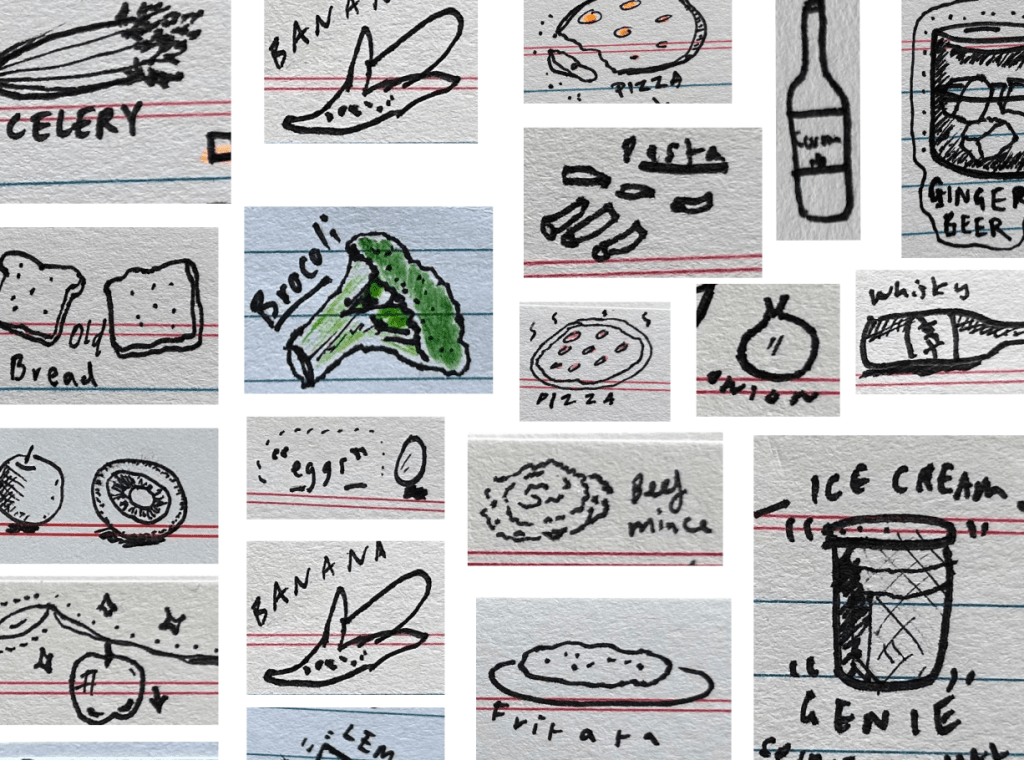
Let’s face it, we are all food obsessed. We spend all day planning our next meal. So I’m not surprised my unconscious made use of chicken drumsticks and bagels. Unfortunately, it’s not the most appetizing collection of food (onion, old bread, eggs). Beer was the most common drink.
Home
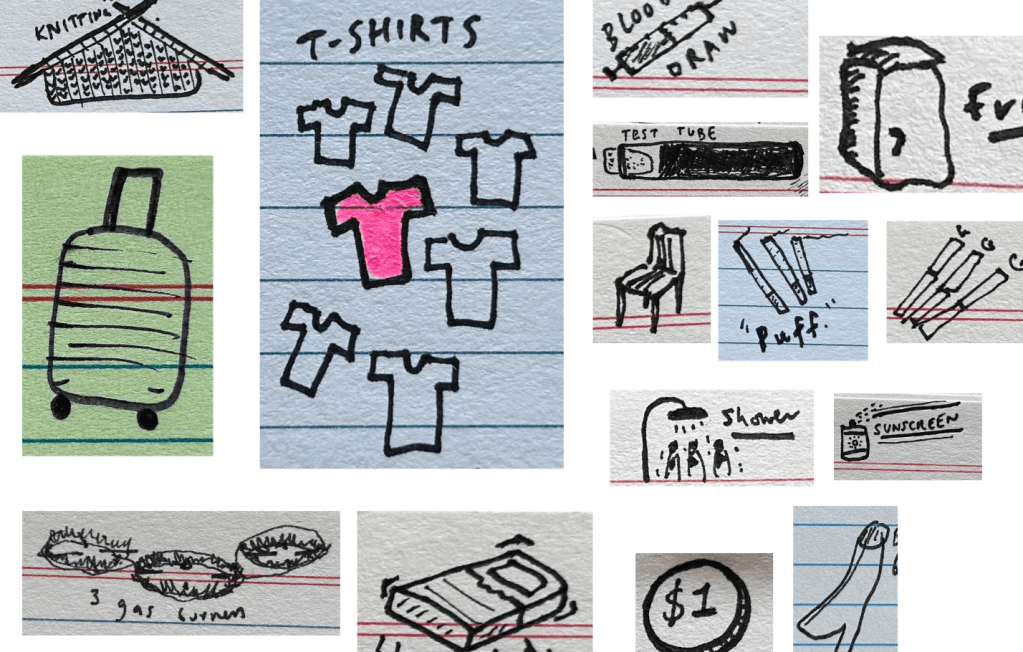
Although most of these items look domestic, it’s because we’ve lost the context of the dreams. The t-shirts for example were part of an elaborate dream set in Israel, where t-shirts indicated your political stance. Cigarettes and pills (ecstasy or otherwise) repeated quite often for me.
Hobbies
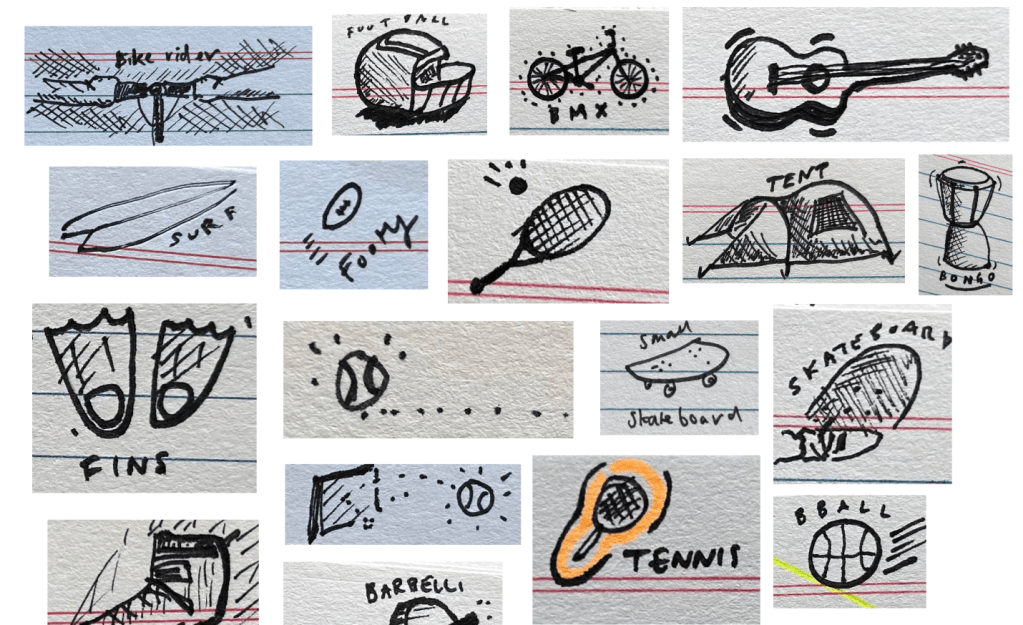
I’m pretty active, so images of tennis balls and bikes makes sense to me. But I haven’t skateboarded or played guitar since I was 14 or so. Images like footy or fishing trips felt like they related to social groups and male friends.
Technology
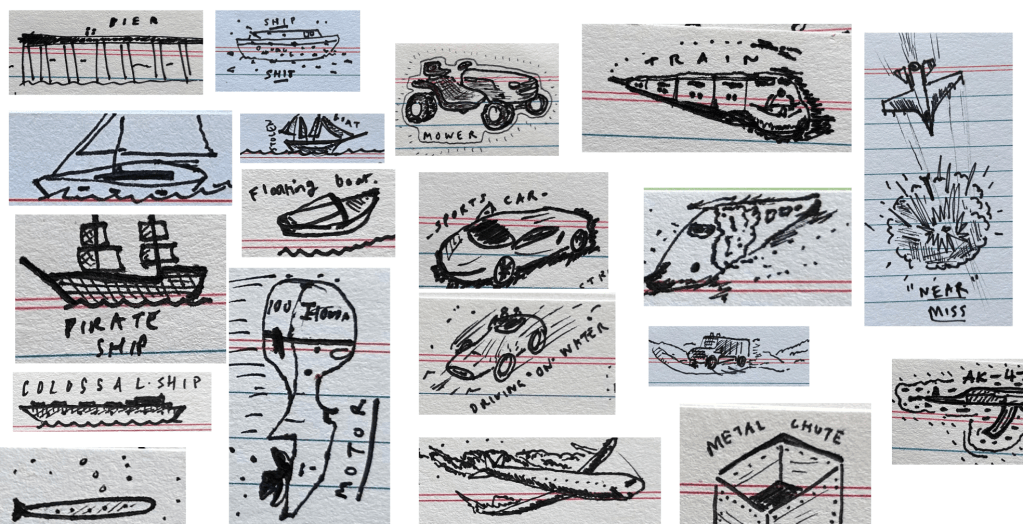
My psyche loves boats. And submarines. And ‘colossal’ ships. For some reason, the sight of big container ships floating across a red horizon filled me with hope and joy. The bigger the better. The other big theme was guns and bombs. Impending nuclear strikes and Uzis pointed in my face were obviously my least favorite dreams.
Natural
Body
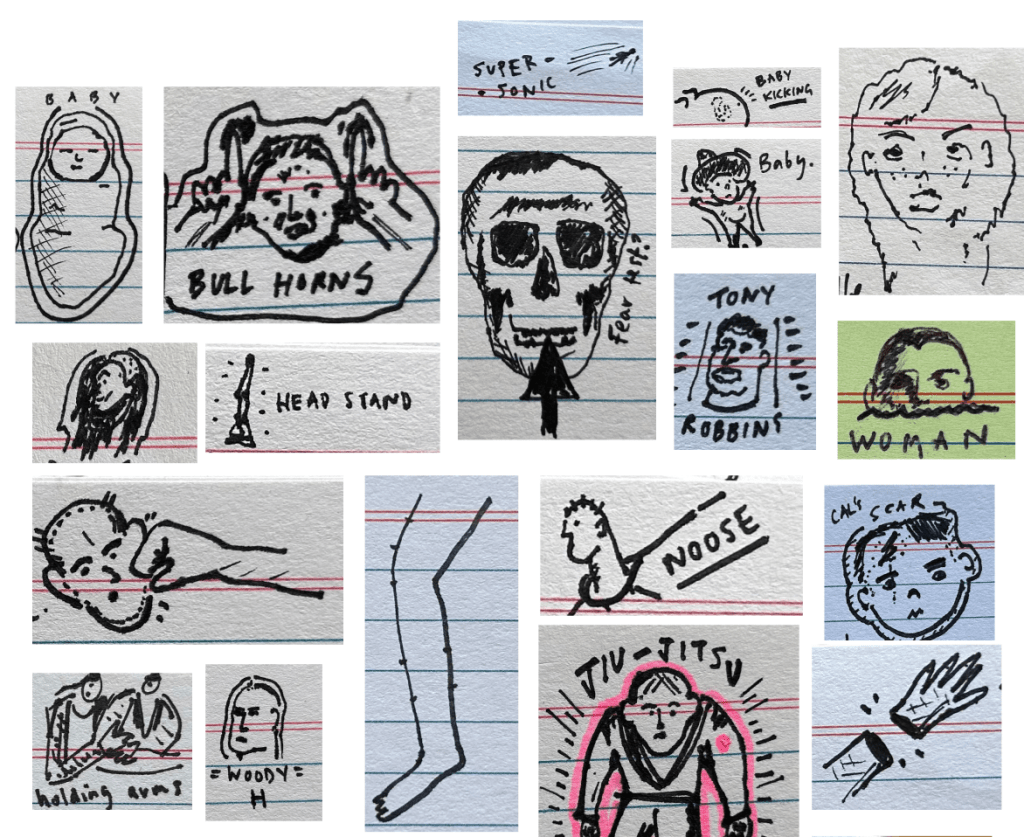
Two celebrities made an appearance here, Tony Robbins and Woody Harrelson. One of my favorite dreams involving my body was the ‘headstand’, claimed by Yogis “to destroy all diseases. to increase the digestive fire, and to banish signs of ageing.”
Animals & plants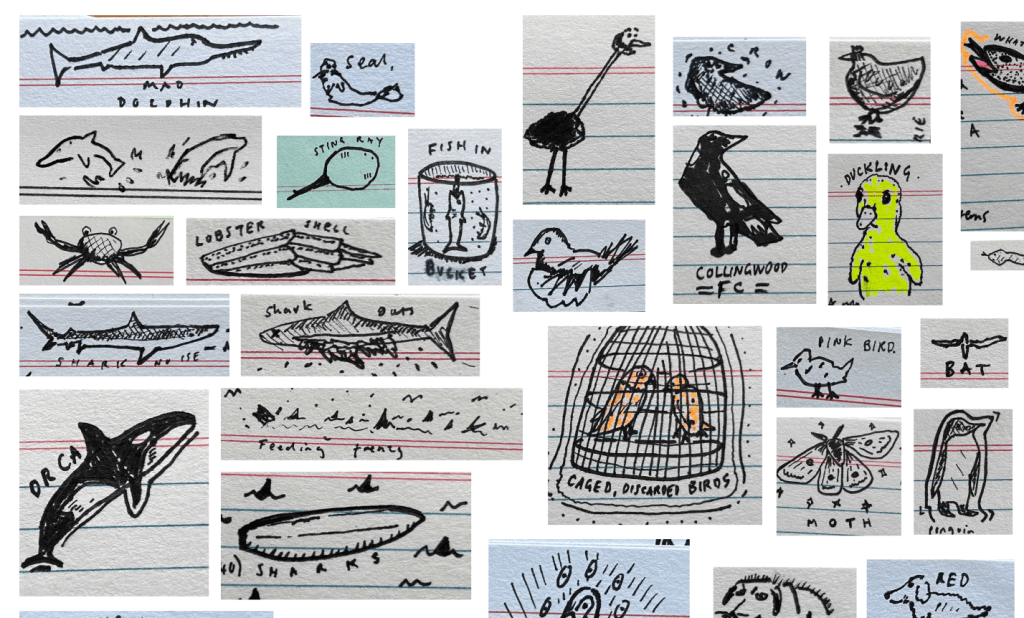
There’s a wide variety here, and I always appreciated a dream animal because they seem to easily convey feelings. Finding caged birds in the trash broke my heart and a wolf filled me with primal fear. They also taught me lessons about myself. A ‘guilty’ dog that wanted to be hand-cuffed and sent to jail for some unknown crime was both funny and prompted me to consider my own tendency to blame myself. The only interesting dream about plants was a specific reference to a large ‘Banyan’ tree, maybe a good symbol for life itself.
Elements
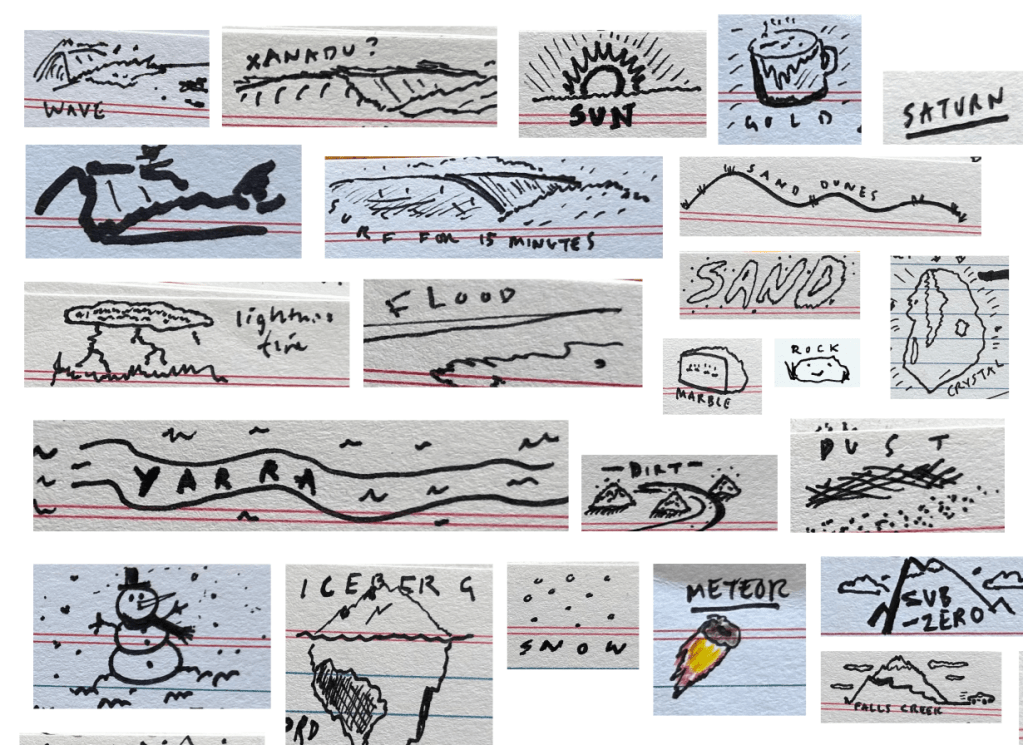
Dreams can forecast the future. I think 10,000 years ago we’d be experiencing a sort of early warning system every night: a lot of storms, rivers overflowing and hungry animals that might directly threaten our tribe. We take in so much information everyday that we’re not conscious of. Instead of discarding it all, perhaps we sometimes receive it repackaged in dreams. One example of this was a dream about a powerful storm that caused spot fires. I took this as a warning of ‘extreme weather’ for an upcoming bike race, where it turned out to be over 45 degrees on the road.
Conceptual
Cultural

I’d occasionally have dreams which I started to call ‘future backwash’. These weren’t particular warnings, but rather just images that I would come across that day or the next. For example, the neon sign of a burger store was part of a dream plot, and I noticed something very similar on a walk home from work (not my usual way home).
Spiritual
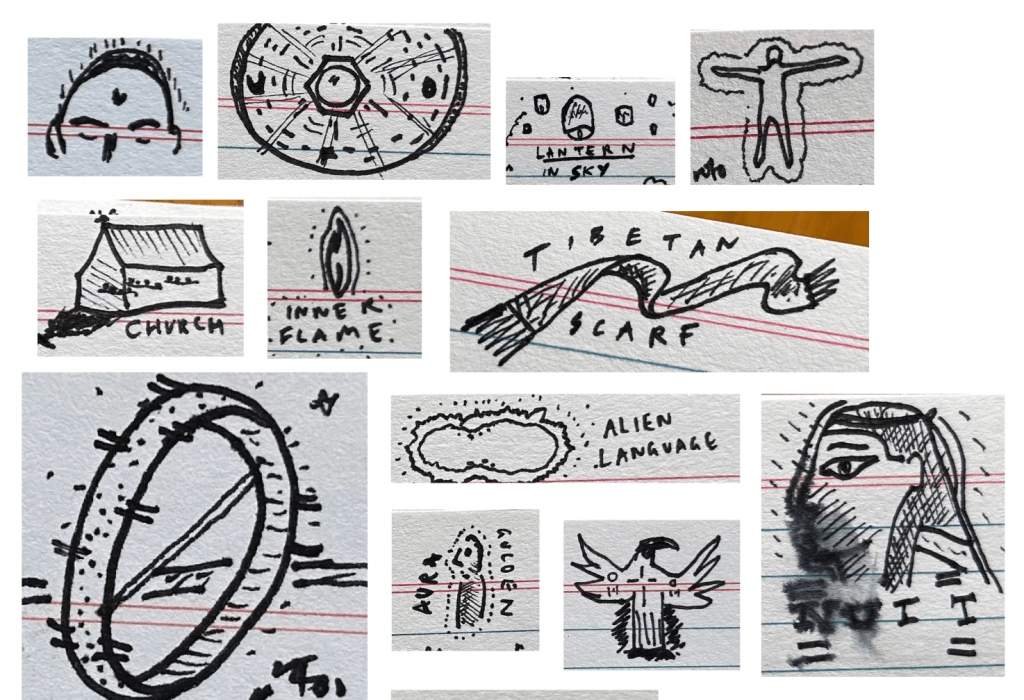
I had a dream where I’m staring at a book by candlelight. We’ve all probably had reading dreams where we are looking at letters but not able to absorb anything. In this case, I recognize ‘NUIT’ and some Egyptian looking drawings. Wikipedia suggests this is a reference to Nut (close enough), the goddess of the sky, starts, cosmos, mothers, astronomy and the universe in ancient Egyptian religion. I’m happy there was no sign that I had disturbed or angered her. 😅
Overall, I’m somewhat disappointed at how vanilla my unconscious is. Where are the shrieking devil monkeys, the green aliens or the fire-breathing dragons? I’ll have to try harder in 2025.
-
Notes of 2024

Girl in the Window, 1880, Giacomo Favretto – July 13, 2024 @ 2.47pm @ Legion of Honor, San Francisco On average I record 5-7 notes to myself per day. Topics range from dreams to creativity to philosophy and everything in between. The majority are only one or two sentences that I think are worth saving. Many are too personal to be of any use to share publicly. I’ve included are about 26 quotes too, and a few notes may be paraphrased and unattributed. Here are 189 of my favorite.
- “Let a life be so full of humility as to be prostrate at the feet of a baby”
- Think of the nicest thing you’ve done recently. Now imagine you won’t do anything better than that for the next 6 months. In other words, lower your expectations.
- “Thinking isn’t knowing.” – Cape Fear
- Nothing is in your control, and you can do whatever you want.
- A bad mood is only bad if it’s unpredictable.
- Memory is described as being “broadly distributed.” Nowhere specific and everywhere at once.
- When we don’t believe in someone’s experience, it sucks out all our curiosity. Openness gives you curiosity.
- The maximum speed (while doing something properly) feels a bit slower than you think. We tend to override our bodies and speed things up, but we end up doing it really badly.
- Meddling with life is like trying to cross a road when there’s a steady stream of cars.
- Basic pounding beats are the only kind of music the left hemisphere understands.
- “We may find movies convincing precisly because we ourselves break up time and reality much as a movie camera does.” – Oliver Sacks
- Hope = Feeling lonely for the future
- There is only one good, knowledge, and one evil, ignorance. – Socrates
- Sometimes people will say “oh it’s so quiet”. This is usually when they are in a park at midday and they are relaxed and maybe they expected it to be noisier but I think it’s more about how they are feeling. When people get to their apartment after work they might say “it’s so quiet” but in a negative way.
- When you feel stressed about doing something in the future, this is based on past things you didn’t like. Your mind is trying to avoid feeling like that way again, so it wants to avoid or to manipulate things to protect you.
- A to-do list doesn’t need to say how something gets done. Maybe someone else does the task. Maybe several tasks get completed together. Maybe completing one task makes the rest of the list redundant.
- We think about creativity like a sudden flash of insight. But why not think about it more like something constantly metabolizing. Basic creativity rate: How many things to you make or produce per day?
- It’s not what you do, it’s the fact that you do anything at all. By applying any sort of action you have committed to working toward something.
- Suffering seems inextricably linked with learning.
- The thought “when is interesting stuff going to happen?” is coming from a place that is unable to know what interesting is.
- You don’t need to believe a belief.
- The old man doesn’t bother with goals anymore. He just does something, in an uncomplicated way. It doesn’t make sense to him to make something more complicated than it needs to be. He doesn’t try to do the washing up ‘effortlessly, or joyously’, he simply washes up. When he lies down at the end of the day, his mind is calm and quiet.
- Is freedom anything else than the power of living as we choose? – Epictetus
- The holy man has spoken to god. The atheist knows we have one life on earth- eg. He had seen death in a battlefield or maybe his own near death. So a deep “knowing” or truth is what they share. It’s like extreme belief starts looking like extreme non-belief. The importance of belief is cancelled out. Both these people “know” things about reality.
- Worry is preposterous; we don’t know enough to worry. – Terrence McKenna
- A man’s (Or Ken, in the movie Barbie) hunger to be understood is one of the strongest in his whole character. A nod of approval, a talisman, even a word—these are the heart and soul of meaning to him.” – Robert Johnson
- Unconsciousness breeds in the comfortable and familiar.
- Everything about you is inherited.
- If your life is relatively easy, the main problem you have is figuring out how to be grateful.
- If you think of the future as probabilities, it’s pretty easy to ‘predict’ what at least the next few days are like. It’s possible that I fly to Russia tomorrow, but it’s much more probable that I go to work.
- It’s appropriate to fundamentally outgrow pride as an emotion… I think pride may be appropriate for childhood…but at a certain point I just think it becomes embarrassing. – Sam Harris.
- Discipline gets confused with abstinence. How about ‘going the right length and no further?’
- Content is less important than communication. “It’s not what you say, it’s what people hear.” – Frank Lutz
- Can you imagine consciously thinking all the negative thoughts you do?
- I’m sitting in a Vietnamese restaurant, staring out the window at a busy road. A bus rolls past slowly, with a huge advertisement ‘wrapped’ around it. I realize this advertisement has entered into the restaurant for a seconds, and entered into my attention. That’s what ads are doing all the time. Entering into our attentions.
- When your mind has been screaming and crying for something and finally gets it – it goes quiet for a bit. But it’s not a nice, peaceful quiet. It’s delusional. It’s like when you give a very rude child what they’ve been asking for. They chortle and pretend there never was any issue.
- If you can happily swim against the waves they will reward you when you turn around and swim with them.
- Every problem is a shoelace that can be pulled straight.
- Hunger is not that unpleasant if you don’t feel additional emotions like anger. Same with a hangover. It’s not dissimilar to feeling tired, yet it’s usually coupled with a lot of guilt and self-loathing or thoughts like “I feel so bad.”
- All your choices are yours. Justifying something yourself is ultimately a waste of energy. Make the best decision you can, with the choices you are aware of being available to you. Take responsibility for it. Move on.
- Happiness never appeared to me as an absolute aim. I am even inclined to compare such moral aims to the ambitions of a pig. – Einstein
- I certainly do not pursue personal happiness. I just want to be understood. People shouldn’t pay attention to me as a person. – Rudolph Steiner
- Don’t take credit for the result because we never know what the result will be.
- Real progress or change in yourself always comes as a surprise. You are supposed to notice that you have stopped or started doing something.
- Telling someone that “next time you are angry, make sure you aren’t going to say something that will hurt somones feelings”… Is like saying, the “next time you drink half a bottle of Jim Beam, make sure to ask yourself if you are making a good decision.”
- The better you are at dealing with your anger, the more responsibility you should have over it. It’s like a Cadet misfiring a gun vs a Navy Seal.
- I feel physically better after getting heatstroke and cycling 170km than a weekend of drinking.
- At a basic level, a haircut tells other people that you care about society, like they do.
- Can you be compassionate to a light switch?
- There’s a monkey and a toucan. The monkey discovers he has magic powers and can grant unlimited wishes. The toucan goes to the monkey and explains that he wants a scratch on his back. But the monkey is so excited with his powers, he doesn’t properly listen. Again and again, the monkey creates all sorts of treasures and inventions for the toucan. Finally the toucan says, ‘enough!’ The monkey is shocked. ‘You mean to say you don’t want any of these things? One by one he lists out all his creations, and one by one the toucan shakes his head indigantly. One by one, they disappear, puff! Finally, it’s just the monkey and the toucan, sitting together quietly. The monkey, finally listening to the toucan, says oh, you want a scratch on the back, I can do that myself! I wish you had told me that in the first place!
- Good and evil both increase at compound interest. – C.S Lewis
- What strengths have been passed down your family line? These could be things like speed, jokes, memory.
- Thinking is usually unhappy.
- There’s intention and then there’s will. So quitting smoking requires an intention (I don’t want to smoke anymore) and will (not putting a cigarette in your mouth). If you’ve done it before, you can stop it.
- The only point of being at ease is to more easily put others at ease.
- Relaxation is what exists when tension is gone.
- You will only realize how strong the tug toward sugar is if you’ve ever tried to resist it.
- Your body wants to be used and feel good. I don’t think it’s interested in living forever. The strength and health of our bodies are means to an end, not ends in themselves.
- ‘Survivalists’ believes defending a basement is better than dying honorably.
- The saddest, most hateful, shameful, despicable thing you’ve done in your life so far is probably funny to someone else.
- Music can emphasize or trivialize feelings we already have. We can experience awe and joy at the sight of a grand canyon, only for dramatic music to make the whole thing feel corny. Or a film score can make you cry real tears.
- The point of competing is to see what happens when you are ‘trying’ your hardest you can.
- A person who is cruel to a defenseless animal will undoubtedly be cruel to defenseless people.
- Everyone is thinking stuff all the time. Everyone thinks while in a particular place – A bed, a park bench, a waiting room. How many thoughts have happened in the back of a 5 year old uber car? How about a 1000 year old Greek orthodox church? How do they differ?
- A friend at work was complaining how ‘low energy’ she has become. She had seen several different kinds of doctors, alternative health.. and complained about a number of negative factors in her life. She feared her energy had gone forever. I bump into her at the end of the day I saw her showing someone around a social gathering, and she was smiling and brimming with renewed focus and excitement. Where had that energy come from?
- Most of the time when you fumble, miss a stitch, tick the wrong box etc, you are simply not looking at what you doing.
- To demand that people take personal responsibility for their behavior is extremely difficult.
- Instant physical boost – Stop exercising for a little bit. Instant mental boost – stop eating for a little bit.
- It’s a great skill to say unexpected things.
- How to be open minded: Don’t accept or reject anything. Just test the validity of it.
- “He who plants a tree knowing that he will never sit under its shade, has at least begun to understand the meaning of life.” – Tagore
- It’s only once we have scaled and reached the summit of an obstacle, can we behold it.
- Everything man has made, he first had to think about it.
- Think of song lyrics as images. What’s important is what emotions are those images soaked in.
- Immortalists are questioning the ‘rules of life’. They want to push the human body way, way past what is considered possible. But what if the limitations of earth are the point? Maybe the whole point is to live as good as you can within the rules of life. Gravity, Entropy, Speed of Light. If one of these things was removed, the universe wouldn’t work.
- Notice the order you do things. When you get dressed, what item do you put on first. Socks? Left or right?
- There’s how many choices you have and then there’s how many choices you think are available to you.
- When you do something fun, like go to a party, or surf a wave, consider of all the people in the world who are daydreaming about what you are doing. For every wave caught, or juicy hamburger eaten, how many more imaginary waves and hamburgers are out there?
- When people get together and work together and learn from each other its almost inevitable they will get to their goal.
- Stress tires the body more than any physical effort.
- Our personality can’t help but make its mark on everything we do. There’s your signature (which is meant to be unique), but how you move your hand, the pen you choose etc.
- People like to hear opinions because it shows where you stand.
- Working in a quiet area of airport maximises productivty by like 3000%.
- Don’t slam the door.
- If life seems to be giving you very rough, simplistic lessons, maybe that’s a sign that you’re not absorbing them.
- Conspiracy theories have two main characteristics: they explain everything by reference to a single factor, and they can never be disproven.
- We are extremely habitual. Pick a different spot to chain up your bike. Eat something different for breakfast. Take a different route to work..
- There are two ways to think about any event, situation etc. One from self-interest, and one from compassion. They are not compatible.
- If left to its own devices, the body doesn’t want to move quicker than it has to. A wild animal would be extremely confused and alarmed if you ever tried to ‘rush’ it.
- Intellect vs intuition. The intellect keeps track of time, makes sure to leave early, worries about running out of time, checks the wristwatch, intuition knows how much time it has left.
- Kids love watching returned library books go down conveyer belt.
- Can you literally not do it, or is it just a matter of comfort? More often than not, it’s about comfort. If you find something difficult, that’s great, because it means you are able to do it.
- “Behaviour is organized around beliefs. As long as you can fit behaviour into someone’s belief system, you can get him to do anything, or stop him from doing anything. – John Grinder
- “Talent hits a target no one else can hit; genius hits a target no one else can see.” – Schopenhauer
- It’s easier to have deep thoughts when we formally ask ourselves a question.
- A great artist sees the world around him as a painting and transcribes it carefully to a canvas.
- “I think it’s the pursuit that screws up happiness. If we drop the pursuit, it’s right here.” – James Hillman
- In order for a fight to happen, at least one person needs to take it personally.
- When people are under stress, tell them what to do instead of what not to do. Tell someone to stay calm, rather than ‘don’t’ panic.
- Extracting the unfamiliar, kills life.
- Even after a nuclear holocaust there would still be dew drops on blades of grass.
- The way you deal with things in your dream is how you really are.
- Photography is about capturing beauty that is already there.
- Meaning is not something we make up, it’s something we find. – Iain McGhilchrist
- Guilt is like the plot of a bad movie. Hard to take seriously.
- A simple problem requires a simple solution.
- We tend to shrug off the fact that our perception of the world is always changing. Look at a streetlight at night, and see how the light blurs and smears across your whole field of vision. If that happened during the day you’d call an ambulance, but we tend to not really notice it.
- When you catch a thought that you’ve had before like “I need to start saving money”, admit to yourself that this is the probably the millionth time you’ve had this thought. Imagine fireworks and explosions like you’ve just won the price is right. Congratulations, you’ve thought this thing 1 MILLION times!
- We get into trouble when we believe we don’t have choices.
- All of humanity’s problems stem from man’s inability to sit quietly in a room alone. – Blaise Pascal
- Any absolute (eg. It’s impossible to work with this guy) should be questioned.
- Before you try and fix your job, try putting way, way more energy into fixing what you do outside of work. If you only have 1 hour of free time, put every spare second into that hour.
- What makes a country ‘healthy’? Certainly some countries seem healthier than others. If you visit a ‘sick’ country, you can return home and feel grateful. Or you could stay there and make it healthier. Likewise, you can move to a healthy country, and be happy.
- Do you hold your coffee cup responsible when it burns you?
- Every time you get lost in some train of thought, your posture will change according to that train of thought – Brad Warner
- If you don’t like the guy, don’t vote for him. Why do you need to hate or kill him?
- When you visit a city you used to live in, if you’re not careful, you’ll find yourself walking around inside a memory.
- Nobody sees a flower – really – it is so small it takes time – we haven’t time – and to see takes time, like to have a friend takes time. – Georgia O’Keefe
- A city multiplies and intensifies your state of mind. Feeling lonely? The city will provide a hundred happy couples. Feeling angry? The city will provide a hundred enemies.
- There’s putting things off… and then there’s lying to yourself.
- It’s always helpful to ask yourself “What can I do to make this go well?”
- “How is it far…if you can think of it.” – Confucius
- Criticism is usually veiled hatred.
- Overcoming an addiction doesn’t mean you abstain forever, it means you can pick up a cigarette, smoke it, and know you don’t want it anymore.
- Gen Z look, talk and act different than my generation, but… they have the same genetics. So it’s the same sexual urges or urges for power, simply expressed differently.
- Culture, at any one moment is a feeling. The content is always new and changing. If you don’t look at American culture for a year, it would only take a few days to get a grip on the feeling.
- Caffeine burrows you down onto specific tasks and gives a pleasure in “doing little tasks” .
- To process information quickly, we tend to filter it into categories and impressions based on what we already know.
- It’s all just a matter of view. Maybe very confident people perceive others as overly young and in-experienced. Maybe natural leaders perceive others as lacking vision or direction.
- “Have a little fun. Make a little money. Do a little good.” – Alan Miller
- You can have beliefs about changing beliefs, like “I don’t think long term change is possible”
- When you send a message to someone, it takes up a little bit of their time to process it and then perhaps they have to do something. Always remember it costs them some time and energy.
- For big questions in life like who should I marry? What job should I do? We almost never have enough data to answer them. That’s why we need intuition as well.
- Most people don’t hate the hunchback. We imagine a person with disability lives a life of shame, but maybe they are actually experiencing a lot of genuine kindness and concern from everyone they come across.
- “I will have no man in my boat,” said Starbuck, “who is not afraid of a whale.”
- How to draw: “He just explained that he looked at what he was going to draw, and then imagined it on the page. He did this a few times until he could see the figure vividly and clearly on the page. Then he would simply follow the lines he imagined on the page until he could replicate what he saw on the outside.” – Richard Bandler
- “A sensitive and honest-minded man, if he’s concerned about evil and injustice in the world, will naturally begin his campaign against them by eliminating them at their nearest source: his own person. This task will take his entire life.” – Fernando Pessoa
- When you wake up groggy at some random time, what did you expect? What did you intend exactly when you went to sleep?
- Go for a run with the intention of not stopping (Pick a distance for you where this is a reasonable goal). Go for a run. Notice how many times you stop. That’s how much interference is going on – from your nervous system, your thoughts…
- The most simple thing a cold does is take away some of your control. When you feel high and mighty the tiniest things can bring you back to earth: Sweat, a cold, a zit on your nose, losing your keys.
- The most painful task is the task that proves that your ego doesn’t know much.
- Discipline is simply anything other than stuff that naturally falls on you.
- Speaking in an engaging way is simply not allowing someone to lose interest in what you are saying.
- There are two terrible things that can happen to you. You can get what you want or not get what you want. – Schopenhaur
- A swim can burn 500 calories. A shower can burn about 5. One is almost no exertion, one takes a lot of exertion. But you feel better after both. So, there’s something about water brushing over our body that just feels good.
- Good leaders can identify who would like to contribute but might not be ready to say so.
- Sport calms the war instinct of a society.
- Self-limiting beliefs are everywhere! Stuff like “my brain isn’t working today.” “I won’t be able to swim as fast as you guys.” “I can’t focus when there’s music playing.” Can’t, never, always, are giveaways.
- Productivity is simply a function of what you’re willing to face directly.
- If you are relatively healthy, you should have MORE than enough energy to get through the day. By that I mean you should probably have an excess of energy. Therefore, exercise is actually just a really useful way to ‘spend’ excess energy.
- There’s no one personality framework. There’s probably an infinite amount.
- Our personality, hang-ups, compulsions, sins are about 1/3 nature, 1/3 nurture, 1/3 free choice.
- When we struggle with a problem, a lot of the struggling is due to a certain ‘type’ of solution that is evading us. For example, we feel we don’t have enough information to decide between A or B. But a perfect solution could be you bumping into an old friend who tells you about ‘C’. That solution doesn’t fufill any of the criteria you had set.
- The best conversation is when the thought to talk about your own interests doesn’t even cross your mind.
- If one doesn’t honour their word with others, they probably don’t honour it with themselves.
- Anxiety is the belief that things are really going wrong this time.
- The most horrible thing in your life has already been experienced – it was the most horrible experience of your life.
- What if you could visually ‘see’ words and sounds that leave your mouth. I’d imagine that singing would look amazing. And negative comments would look like little barbs.
- I hear a story about someone’s aunt. She got lost trying to find a cafe, because she refused to use google maps. Some people have a very small mental map of world – limited by their beliefs and stories. That woman didn’t even have a literal map!
- “Writing novels is hard, and requires vast, unbroken slabs of time. Four quiet hours is a resource that I can put to good use. Two slabs of time, each two hours long, might add up to the same four hours, but are not nearly as productive as an unbroken four” – Neal Stephenson
- Eyes that are constantly blinking means your thoughts are restless.
- A jungian view of Hitman (2024). The protagonist is living a meek existence. It’s him and his cats alone. He’s all theory, no practice. He’s comfortable but extremely limited. But then, as an undercover agent, he starts trying on new personas. This unleashes a lot of energy. All that creativity that naturally comes to him was sitting around untapped. This attracts a woman. He wouldn’t have been able to meet her if he didn’t grow out of himself. She attracts him, inspires him, shows him many new sides of life. She’s even dangerous (she kills someone!). But together they are better. He’s more whole. Partnering with her makes him whole.
- But in the NFL, very few (Quarterbacks) are naturally at peace. And that’s why when I compare him to Patrick Mahomes, I’m comparing him to how Patrick feels at peace… Patrick showed up at peace, and so did Brock. The draft doesn’t understand that thing.
- A journalist burns out. “Birding” solves his anxiety. But this guy is such a high achiever, he can’t help but become really good at birding. Although he’s healthier than when he was writing about COVID, he can’t recognize his unquenchable drive to achieve and be ‘good’.
- When people do religious things it seems like our general nature is to give them space, quiet and some respect. Why can’t that be applied to any activity? Jogging around a park, or feeding ducks in a pond?
- “To be a civilized man,” he said, “you need two qualities: compassion and the ability to block punches – Hemmingway
- Whenever you return back to reality from the clutches of a bad mood, it can never be on your own terms. Because your own terms were the initial conditions for the mood. There has to be another element. A negotiation, a request, a new insight or perspective.
- The enneagram is an ancient personality system that essentially divides people into 9 groups from ‘1’ to ‘9’. The ‘3’ is concerned mainly with the image of winning and can lie casually and freely to serve that goal. Most American presidents were ‘3’s’ (Trump, Carter, Kennedy, Reagan etc). Interestingly not George Bush. One could say that America itself is a ‘3’ because it mainly cares about winning.
- Every time I’ve overcome any ‘problem’ in life, I’ve found I have the ability to overcome a slightly more ‘difficult’ one. It’s painful, equally painful each time. So the saying goes – “It never gets easier, you just go faster.” Eg. At level 2, you can handle level 2 problems. At level 3, you can handle level 3 problems. Therefore, it’s true then that the present moment should always be able to teach you something. Even if you rock up to Spanish class a million times, each time will be a new lesson. You might find yourself thinking ‘oh I’m just doing silly class because I’ve got nothing better to do with my sorry life – I’m no longer learning like I used to.’ And damn, that’s a persuasive thought. That thought.. that exact thought.. thats your exact reality at that moment. That’s what you’ve got to meet.
- A few new staff join the design team. They come from other big tech companies or large corporates like banks or telcom. They are smart but they bring a predictable way of working – honed for years in a pretty specific type of environment. I feel a little disappointed. Employees make up most of the culture. I think, it’s unlikely this person is going to snap our ways of working out of their ruts. Someone from another large company will bring their brainpower of course, but easily sink into a groove again. Ideally you identify people who can both ‘fit in’ and influence positive change.
- There are some days when the outdoors seems very ‘alive’ and appealing. This might be a day where you wake up early, without an alarm. This is a good day to do exercise.
- Ideally we would admit what we really want. But in many cases, we unconsciously do the opposite. We ‘write off’, ignore, or even hate things that we want. If someone believes they are not smart enough to go to college, it might be too painful for them to admit what they want. Instead, they might say ‘I’m not really interested in college.’
- We never know exactly what will cause us the most pain. I spend weeks dealing with a trouble at work, only to feel twice the discomfort when I lock my keys inside my house. Similarly, we never know exactly what will delight us or make us laugh.
- There’s many ways to work faster, if you’re aware of them. We are slow when we only know one way of working (or doing anything). Don’t care how you look, ask for help, cheat, take a shortcut: these are all ways to go faster.
- I tend to speak from my gut, meaning I don’t really think carefully before I speak. Some people speak from their head, or their heart. A good nurse intuits words that make a patient feel safe and reassured. A good computer programmer intuits words that are logical. A salesman intuits words that are persuasive or engaging.
- “People who have a creative side and do not live it out are most disagreeable clients. They make a mountain out of molehill…there is a kind of floating charge of energy in them which is not attached to its right object.” – Marie-Louise von Franz
- In order to sing or act convincingly, you need to actually believe whatever you are singing or doing.
- Some people (Hitler being the most extreme example) are ‘counter-phobic’. It’s a tool, not a personality. When in doubt, they bite whatever is threatening. Their whole life is about rooting out (perceived) dangers.
- Why does feeling sad feel so ‘bad’? It might be because we are trying as hard as possible not to feel sad.
- Anxiety, when it’s slowly starting to increase, can be mistaken for excitement.
- 9 times out of 10, listening is more helpful than offering advice. Jonathan Shedler, a therapist, agrees: “If there’s one thing we’ve learned in more than a century and a quarter of treating mental and emotional suffering, it’s that giving advice doesn’t help.”
- Hesitation invariably causes trouble. It spoils ‘good’ acts. It kills our natural spontaneity. So when you find yourself hesitating, it’s worth investigating. What word, feeling, action has caused you to hesitate?
- A lot of frustration at work or with personal relationships can be solved by taking some small proactive measure yourself, rather than waiting for the other party to do the thing you want. For example, at work, I wanted co-operation, feedback, engagement from stakeholders. But I didn’t get any until I shared a proposal myself.
- Don’t be late. Ideally, you never even think about ‘being late’. You just plan so you arrive early enough. So with a bit of planning, prioritizing, one should never really need to ‘rush’.
- Places that seem to inherently have a good feeling about them: (Most) Primary schools, Parks, Benches, Places of worship, Sporting fields, Playgrounds, Libraries, Clubs, Small farms, Camps.
- The only thing that reliably makes people laugh is when I’m not afraid to look bad.
- Someone slipped and tore their achilles during a tennis lesson. The mood of the group turned subdued, sad and a little fearful. The coach commented on this atmosphere and I noticed him trying some things to cheer us up. Humour, playfulness, mock aggression seemed to help. It’s a bit like when a speaker asks a bored, sleepy audience to get up and wiggle their arms stupidly for a few minutes.
- I’m drifting off to sleep and I feel the strongest sensation that someone is breaking into my house. Every cell in my body tells me that this is real. Yet a small part of me knows that it’s not. So I try to listen to that part, and relax. The sensation, and the associated images die down. What just happened? It’s simple. I experienced fear, yet I didn’t buy into it. I think this is a healthy relationship to have with fear. Since we can’t avoid it, we just need to manage ourselves while in its presence. Okay, I feel scared, but what actually needs to be done?
- Fitness & mobility test: Jump out of a swimming pool without using your knees.
-
Compulsion – Two years of Buddha Bike

July 2, 2024 @ 7:50pm – Petaluma, CA Articles
Since January 2024, I’ve published 34 posts on topics like the personal unconscious, time, the future, anger, the body, therapy and food. This is about 10 posts less than last year. If I didn’t feel like I had anything to write about, I simply didn’t write anything. Experimenting with different styles and formats (eg. A conversation, a how-to guide or very short sentences) helped a bit. Personally, 2024 has been about unravelling compulsions, whether it be habits or feelings like anger or resentment so that I can make more normal choices.
- All purpose Cheer – Touring around Taiwan by bicycle
- Compulsion
- A conversation about Free will
- Non-intended doing
- Unadmitted thoughts
- Flat tire
- An hour is always an hour
- Determined
- Draining the tide pool
- The importance of being earnest
- Past and potential lives
- Everyone’s a winner
- Did not finish (DNF)
- Eating things
- 12 unpopular opinions
- What’s the point
- Drowning
- The Talking Cure
- The Trolley
- Seinfeld the Stoic
- Street furniture
- For the love of money
- Painting into corners
- Exercise as exercise
- Seeing through a blind spot
- The power of negative thinking
- The dose makes the poison
- Mortgaged energy
- Sticklers
- How to Decode your Dreams with AI
- Dog, Tree, Mountain, Person
- Move the goalposts
Book reviews
- The Laws of Human Nature – Robert Greene
- Subliminal – Leonard Mlodinow
Notes
On average I record 5-7 notes to myself per day into Apple Notes. Topics range from dreams to creativity to philosophy and everything in between. Many are too personal to be of any use to share publicly. The majority are only one or two sentences that I think are worth saving. Below, I’ve curated 189 of my favorites.
-
Move the goalposts

November 3, 2024 @ 11:41am – Lavers Hill, Victoria I want to swim faster.
That’s what I thought.
I was tired of lagging behind the others in my swim group.
So I wished to go faster.
When we invent goals like this, it’s easy to miss how many hidden assumptions are packed inside.
We assume that ‘going faster’ is what needs to happen.
We assume it will make us happy.
We assume it’s even possible.
Lots of things like that.
We don’t think through any of that. We just want something.
But really, we haven’t thought through anything.
How much faster were you thinking? Just for this lap? Or forever? Were you thinking it would be gradual, like a bit faster every lap? Do you keep getting faster until you reach olympic speed, and then what? What do you think the others would say if you started swimming twice as fast? They’d kick you out! So did you consider that your not very thought through goal has some risks and unwanted effects attached to it?
That’s why we often feel frustrated with where we are at in our lives.
We have set all these little flimsy, hastily thought-through goals that we probably don’t even want to achieve if we spend the time to think about it.
It’s like those #isitcake videos on TikTok. Something looks like a tube of toothpaste or a coffee cup, but when you cut it with a knife it’s actually made of cake. There’s nothing there, except some flour and sugar.
When we question the goal, other possibilities suddenly arise.
For example, one morning I was rushing out of my house so I wouldn’t be late for a meeting. But a thought crossed my mind. I could take this first meeting from home. The ‘get to work as fast as possible’ goal disappeared. And in an instant I was suddenly early for the meeting, because I didn’t need to go anywhere.
So instead of fixating on a goal, open yourself to some other possibilities.
If we go back to that swimming goal:
- Did you consider that it could be achieved without you doing anything?
- What if the guy in front of you gets a cramp? What if everyone else in the pool gets a cramp? Suddenly you’re the fastest swimmer.
- What if you moved into the slower lane? You’ll feel a lot faster.
- What if you took less breaks (you’re not faster, but your average speed just increased).
Maybe this is moving the goal posts.
But I think the goal posts are better when they are moveable.
You can also read this on my Substack
-
Dog, Tree, Mountain, Person

November 3, 2024 @ 6:18pm – Beech Forest, Victoria If you talk to the animals they will talk with you and you will know each other. If you do not talk to them you will not know them and what you do not know, you will fear. What one fears, one destroys.
Chief Dan GeorgeThe dog
First of all, it’s hard not to like you. We instinctually like people. We like to be close to you at all times. That’s why you need to kick us out of the bed. Why wouldn’t we want to sleep together? We are so grateful for all those things you do for us: Cleaning, feeding, petting. How did we get so lucky? And what more, life is exciting, isn’t it? We are excited about the sun, the air, the bouncy ball, the neighborhood roads. It’s very hard for us to understand that you might not feel the same way. We’ll never quite figure out why you prefer to be clean and walk around like you do. When you are angry or anxious this is very frightening for us. You don’t seem to be able to see how obviously unpleasant these things are. We can feel every vibration of an angry footstep or slam of the door. We shut our eyes and try and pretend we are having a bad dream. When you shout at each other it feels like you are throwing little needles at our ears! We wish you wouldn’t. But we can forget quickly, and a lovely warm tone of voice is like heavenly music to our ears.
The tree
We’ve got a good view from up here, especially us old folk. I’ve been alive for hundreds of years. That’s enough to see a few generations pass by. The kids, growing older, people leaving and going. You all think you’re the first to do something, but in most cases there’s been people doing similar things to you before. I’ve seen a lot. Every day lots of people walk past me. Most of you are hurrying. We can’t hurry. We settle in one place and we ‘bed down’. We grow up and down and out, but we don’t race around like you lot. Most of you hurry past without looking, staring at your phones and sometimes tripping on our roots, which always makes us laugh. Animals and insects show us more attention. Animals don’t really hurry. Even ants go at a ‘proper’ pace. But I like being useful, like you do. I do lots of little jobs for the environment, plus I’m good to look at. But I just don’t get so stressed or focused on productivity like you do. Some years I just don’t grow very well, or give much fruit. That’s fine by me.
The mountain
From up here, you all look like ants. It’s a little too hard to make out all your little goals, aspirations and plans. To us, they all sort of all blend into one thing. You think a tree has seen some things? We’ve seen entire civilizations come and go. Wars. Famines. Diasporas. Humans really get to do a lot. For us mountains, we really are in for the long haul. That’s not to say we can’t appreciate the small things. The clouds, the sun, the wind. The snow thawing in the spring. We understand all that but there’s not much point thinking ‘day by day’ when we will be around for millions of years, and from a certain perspective a mountain never dies. It’s fun to see the more adventurous humans scale our faces. It doesn’t make much sense to us, but we hope they have a good time. Some slip and fall but we get the sense that they were go out doing what they loved. Humans are always ‘proving something’, but once you get to our size and strength, what’s left to prove?
The Person
Peering through another persons eyes can be a bit unsettling. Perception is everything and through your eyes, the world looks so different. I’m stuck holding your map, which is filled with so much information and instructions. It tells me who my parents are, my height, my ethnicity. It’s got all your memory – everything you’ve ever experienced. But it’s also subjective. That’s the hardest thing. I take on how you feel about those things. How you feel about your history, your job, your face. Your addictions drag me in one direction, leaving me stuck in little habitual whirlpools. In some areas of life I can see my options dry up, as I’ve settled on a ‘certain way of doing things’. And of course your fears. These are like little stones dotted across your life that you have avoided turning over and looking under. Most of all, I’m ruled by your thoughts. Most of these are boring and repeat over and over. Self talk. Opinions about everything. We could do with less of these. More peace and quiet. It’s not a bad life that you’ve got, but it’s noisy in here!
-
How to decode your dreams with AI
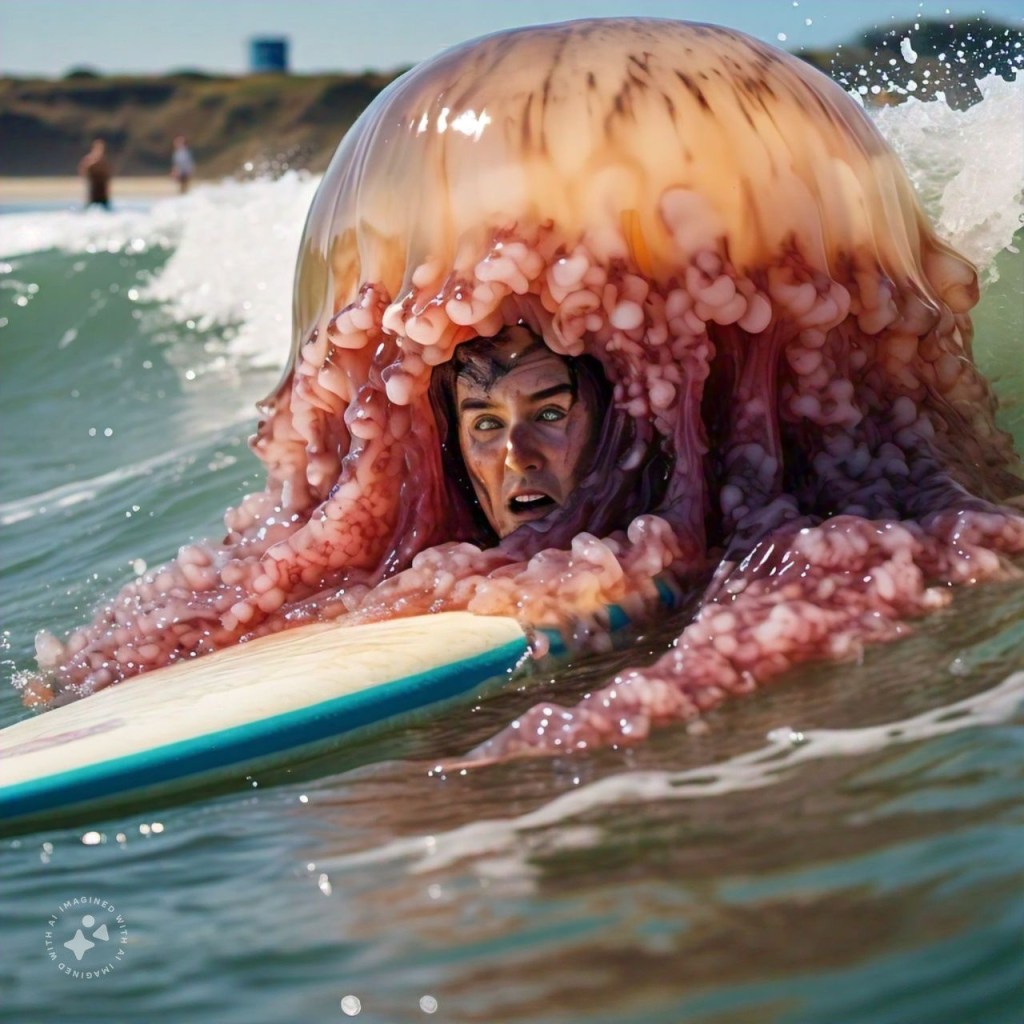
A dream where I was engulfed by a giant jellyfish – ‘Imagined with AI’ All dreams are good dreams. They’re giving you information which you need.
Robert A. Johnson
Until you make the unconscious conscious it will rule your life and you will call it fate.
Carl Jung
The main point of any sort of therapy is to bring form or consciousness to what was previously unconscious.
One method to do so is to better understand your dreams, which could be said to contain images, thoughts and feelings that were previously unknown to your conscious mind.
But there are a lot of barriers:
- Most people don’t believe there is any value or meaning in unconscious material.
- Dreams are not only seen as unimportant, but culturally stigmatized as weird and kooky.
- For a number of reasons, it’s difficult to remember and record them.
- Dreams are primarily images and don’t spell things out like a business report. So it’s very hard to understand them straight away.
For those reasons, I doubt many people interpret their own dreams. Providing tips in this area feels a bit like writing about the correct nutrition strategy for Antarctic distance running.
And I will admit that interpretation is hard, frustrating and I’m not very good at it. For most of the dreams that I write down, I take one glance at it and never read it again.
But I’ve been experimenting with offloading some of the dirty work to ChatGPT and other AI tools and found it to help, even if it’s just the feeling that I don’t have to do it all by myself!
The process I’ve outlined below is based on Robert A. Johnson’s method he writes about in Inner Work. Johnson was a protege to Jung and really was able to translate and popularize dream work to the masses.
Step 1: Write out the dream
It’s important to have clear source material. Dreams quickly become fuzzy, but if you’ve got a couple of sentences on paper, it’s much easier to interpret.
How AI can help: You could skip the rest of the steps and try and grab an interpretation straight away. For better results, provide some recent events or how you are generally feeling. Eg. I’ve been interviewing for a new job and feeling very disappointed with how I’ve been going so far. You could ask it to visualize the dream (see jellyfish image above) which can lead to some fun results, and is a worthwhile practice in itself.
Step 2: Make associations
What does a dream with lightning in it mean? If you ask google, you’ll get a lot of different, contradicting results. What really matters is less about what some dream dictionary says, and more about your own unique, personal associations.
Take this dream for example: “I’m in a town square in San Francisco where the mayor, a black woman, was waiting for people to show up.”
For me, I associate San Francisco with things like home, America, ambition, freedom, technology, money, business, career. That’s because I’ve lived and worked there and that’s how I feel about it. If you’ve never visited and spend a lot of time on the internet, you might associate it with hell or homeless people. Dreams rely heavily on images to communicate their messages, and do so with “maddening economy. They won’t use two words when one will do. And they leave out connectives like so or therefore.” 1 It’s our personal associations that can help us ‘double click’ on these images rather than reading the dream like a linear story, which usually won’t make much sense.
How AI can help: A tool like ChatGPT doesn’t know anything about how you personally feel about red socks or the hamburger you cooked last night, but it can help a lot with bigger, more collective associations. Let’s look at the town square image from that dream. Jung saw the town square as a symbol for the Self, symbolizing the integration of various aspects of the psyche into a cohesive whole. The town square is also the ‘heart of the town’ and is a public space that could represent concerns about public image, reputation etc. These broader associations might not feel right to you, but occasionally can flick on a lightbulb. Humans have been working with symbolic images for thousands of years, and GPT can tap into that vast database and make associations that you might not have made by yourself.
Step 3: What part of you is that?
It’s normal to distance your conscious self from all the images you might encounter in a dream. For example, it’s easy to dismiss the image of a soldier as someone else or simply meaningless. Maybe you’re unable to draw out any associations, personal or collective, that make any sense. But in this step, you want to ask is there any part of yourself, a trait or dynamic, that you might share with that image? For me, I struggle to see anything ‘war-like’ in my life or self, but I could admit there’s a part of me, or a dynamic in my life, where I can blindly follow orders and switch off my critical thinking without questioning a task or speaking up for myself.
Step 4: Interpret the dream
If you’ve made it this far, you’ve got a dream, associations, reflections, and hopefully some insights that have naturally arisen during the process. It shouldn’t be too hard to take a stab at what this dream might be trying to say.
You know you’ve done a good job, when you feel a little shocked, embarrassed, sheepish or even annoyed at what you’re looking at. That’s just your conscious mind smarting as it contacts and understands something it didn’t want to admit to be true.
How AI can help: Your own interpretation will likely be best, but it’s still easy to deceive ourselves and say ‘oh yeah, it’s about work’. But a second opinion from the LLM gods can help you catch anything you missed or unconsciously brushed over. You could ask it to come up with an alternative interpretation or play devils advocate.
For most people, dreams will remain far away from the spotlight of the conscious mind. But that doesn’t mean they don’t exist, or contain useful, practical information that you would probably be better off knowing about. Accurate analysis will likely to continue to be tricky for most of us, and require a good amount of patience and intuition. But hopefully tools like GPT can help with some of the heavy lifting: to amplify associations, research symbolic meaning and look at our psyche from new angles.
-
Sticklers

February 4, 2022 @ 8:33am – Freeport, Bahamas Irritability, bad moods, and outbursts of affect are classic symptoms of chronic virtuousness.
Carl Jung
Sticklers are people who can’t help but be serious, orderly and neat.
Sticklers can’t help but have clean and tidy houses. Before they leave to go to work, they dust and straighten things. They bring out the big guns before they have visitors. It’s important for everyone to know they are clean and orderly. Rubbish will be carefully separated. The back of the fridge will be sparkling. There will always be extra rolls of toilet paper.
Sticklers set a high bar for themselves. They might find it a little hard to relax until they have ‘finished all their tasks.’ Once everything is perfect and good and in the right place, they don’t relax much, they think ‘ok, now let’s keep up this standard forever.’
The Stickler doesn’t realize that they will never be able to make everything perfect and good. In fact, measuring and judging makes things worse. You can easily ruin a dish, a drawing or a friend with harsh criticism and high standards.
The Stickler is constantly dissatisfied with the present moment. There’s always something a little bit wrong that catches their attention. A little cut on their finger. A certain smell. A piece of work that is not quite finished. A little stain on their shoes. The obvious fact that life is a mess doesn’t relieve the stickler. Instead, it makes them exasperated and frustrated.
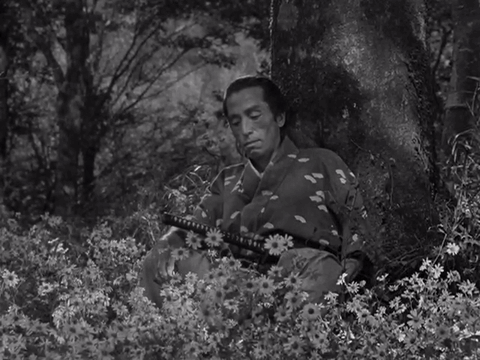
Kyuzo in Seven Samurai (1954) Samurais are Sticklers. They follow strict guidelines and view themselves as honest and orderly. They really believe there is a perfect way to do anything and everything. In the film Seven Samurai, the samurai ‘Kyuzo’ initially refuses to join the team because ‘he’s not interested in killing, only in perfecting his skill.’ Once he comes onboard, he’s quiet and effective, but seems unsatisfied with his work. He comes across as the most judgmental and righteous of the bunch.
Sticklers get on each others nerves. It’s one thing to be punctual, but when everyone is punctual it’s a bit too much. It’s hard to rationalize all the neatness when they see someone else do it. They don’t want to be surrounded by neat-freaks, they prefer to keep their neat-freakness to themselves. I think that’s because it’s hard to feel like a saint when you are surrounded by them.
Sticklers feel guilty and freak out when they lose control over their saintly self-image. They can easily get angry, but since being angry isn’t very virtuous, they have trouble admitting to and owning that emotion. All that energy needs somewhere to go, and usually gets placed onto whatever is closet to them – A collegue, a partner or the tomato they are chopping up.
Sticklers can be angry, but even more so judgmental. The Stickler has weighed up, judged and critiqued every molecule of their being before they have even gotten out of bed. Once they have finished with themselves, they move onto anyone or anything else in their close vicinity. A housefly isn’t safe from the Sticklers’ endless campaign of criticism. By midday, they can feel like a broiling cauldron of negativity and are not that fun to be around.
The Stickler is happy if they can avoid anything that makes them look bad. It’s healthy if a Stickler can get in the habit of sharing something quickly, roughly and ultimately imperfect. If a Stickler has retreated into private and is working on getting something ‘just right’, you know they need to come back to reality. For designers, showing your work all the time is critical to a good design process. As Bob Baxley, a former design leader at Apple says, “If you ever found yourself sitting at your desk by yourself with your headphones on, stressing ’cause you felt like you had to figure it out on your own, something was really broken.” This is good advice for Sticklers.
Is there any hope for someone like this? Nature can serve as a partial antidote for a Stickler. If they can occasionally ignore their neat-freakiness and step outside, they’ll find a whole bunch of leaves, dirt, mud and water that ultimately can’t be ordered in any ‘right’ way. A tree can only be a tree. Same goes with a mouse or a stick insect. Nature, as Jung puts it, “harbors no intention to deceive, but expresses something as best it can, just as a plant grows or an animal seeks its food as best it can.”
Read this article on Substack
-
Subscribe
Subscribed
Have a WordPress.com account? Log in now.

