-
This time it’s personal

December 26, 2024 @ 3:09pm – Mt. Martha, Australia I bet they’d love your sparkling personality – Carol Sturka, Pluribus
The easiest way to piss someone off is to poke fun at something they take personally. Their haircut. A pair of brand new sneakers. Don’t do this. They will get annoyed. Because when something is personal, it hurts.
The personality is a project that we’ve all poured a lot of time and resources into. It’s what we show off in our elevator speech or on a first date. It’s our personal trivia, odd quirks and what we’ve tried to desperately iron out and improve with therapy, self-help books and travels abroad.
Take me for example. I’ve always liked to ride bikes. I might even say that I’m a cyclist. But if someone thought that I was riding 50km/h in a bunch of fitness freaks every morning at 4am I would get a little upset. That’s not me, I’d think. I’m not that kind of cyclist. Even if it’s close to the truth, I’d feel a bit annoyed and misunderstood.
I also have this blog called Buddha Bike. You should read it! But I’m not a Buddhist. I don’t know any prayers or have a favorite sutta. I don’t wear robes (unless my dressing gown counts). I would get upset if I was introduced as Buddhist. That’s not me! At least, that’s not how I think of myself. Writing this blog is tied up with my personality, so I’d take those comments personally.
It hurts when we take things personally, but it also hurts more when we take things too seriously. When I’ve written (here and here) about taking things seriously, I meant it in a much more positive way. Like “singing like your life depended on it”. That’s what a concentration camp survivor told David Lee Roth, who then followed that advice for his whole career. Or it’s like when we participate in a race and we don’t care about the result, we just try and do our best (even if our best might fluctuate wildly). This is what we should encourage kids to do. This is what growth mindset is. It’s wholehearted. Maybe we could call this healthy seriousness.
In comparison, unhealthy seriousness is cringing, defensive, overly sensitive, fearful, neurotic, self-conscious and self-absorbed. Sounds like fun, right? It’s a fragile attitude and position to take on life. Like a tiny quivering half-blind Chihuahua, it’s got no choice but to end up scared and barking at a streetlamp. For example, if one takes their appearance very seriously, they’re suffering every time the wind ruffles past their hair. If you take the formatting of your word documents really seriously, you’re suffering when someone comes in and changes the font size. You were too serious. You clutched onto it too tightly, and now your hands are bleeding.
To escape this pain, people have found all these different ways of taking themselves less seriously. There’s the extroverts who seek out the attention, turning their faults into fame and enjoying a heavy reality distortion field. But they can also be dangerously unhinged and narcissistic. There’s the monks who have switched off their personalities but live alone in a cave and are scared to turn the lights on. There’s preppers who don’t trust or need to rely on anyone, but end up paranoid and alone. And there’s the few who have been able to unplug themselves from society’s rules but end up disconnected from themselves and others, making normal relationships and jobs impossible
Although I can admire these types from a distance, purely for their ability to shed self-consciousness and sensitivity, many of these ways of living don’t seem that healthy or appealing.
Instead, we could be finding ways to relax this seriousness, like author Robert Moss writes to “look at your issues and life choices … without judgment and always (I trust) with a sense of humor.”
One way to do that is finding ways to laugh at yourself. Can you laugh at how you are rewriting that post on social media? Can you laugh at yourself picking out the right shirt to wear? Can you admit that you’re being a little bit too serious about it? Some of us have turned something like a profile picture into a matter of life or death.
But unlike seriousness, humor always feels like relief. Laughing deflates. Releases pressure and tension. Unclenches. You’re basically laughing at the world not ending. Annoying stuff still happens. Disappointing stuff still happens. But we don’t need to take it seriously1.
-
100 thoughts

December 15, 2025 @ 2:21pm – Mount. Madonna, CA We all have a ridiculous number of thoughts everyday. Most are invisible. Most of the rest are like a highly repetitive radio station. But there’s the occasional thing – a quote, an observation, an insight, a dream, an idea, that is worth sieving out of my brain. In 2025, I wrote down about 2000 notes. Here’s 100 of them, in loosely chronological order.
- Being sad is natural, it’s not a crime.
- What thing will you make into a problem next?
- Go for a walk at dawn or dusk
- It’s actually a good thing to not know what to do next
- One of the things the body likes the least is to be ignored
- Flirting: The pleasure is saying “I think you’re hot” without saying it.
- Instead of asking “are you ok”.. we should be saying “what incredible thing you’re doing. How can I help?” – Marienne Williamson
- If you don’t follow pop culture, you start to sound naive. I say “did you see that touchdown?” and my friend says “he’s a horrible human being”
- In what way is it useful or important to explain the ‘true nature’ of reality?
- More than you’d think, people just want to vent.
- Watch the urge to show off around a mentor, expert, guide, or therapist
- One of the best feelings is ‘having each others back’
- Spiritual teachers have taken on an incredible burden: dealing with the questions from spiritual seekers
- “If you have two pennies left in the world, buy a loaf of bread with one and a lily with the other.” – Chinese
- Months of dedicated training : + 20 watts. Skull bandana: + 20 watts
- I realize that if a car creeps up behind you the simplest thing to do is slow down and let it pass. The car gets what it wants. You get what you want.
- In what circumstances did their current behaviour make sense? – Alain de Botton
- Yawning is usually a nervous tick rather than a good signal of tiredness.
- Addicted: You never get what you think you’ll get. And once you’re past it, you don’t want what you wanted.
- If I have to suffer, then let it be from my reality. A neurosis is a much greater curse! – Carl Jung
- A child is poking at a bee. A Spanish nanny is urging him to “Leave it alone. It’s beautiful.”
- They say Emperor Tai understood the universe by understanding people.
- I have received more than enough good advice in my life, but so often, all I’ve heard is scolding and patronizing.
- “Religion is regarded by the common people as true, by the wise as false, and by rulers as useful.” – Seneca
- Imagine you’ve just realized you are dead. Imagine you’ve just realized you are alive.
- Little kids walking themselves to school: Some are being kids, some are being their parents.
- A perfect ad: A sign stuck on a fence next to a fresh paved driveway reads “Hot Bitumen Driveways + Phone number”.
- Therapy is like someone gently pointing out a tattoo on your arm that you forgot you had.
- “It is hard to have a Southern overseer; it is worse to have a Northern one; but worst of all when you are the slave-driver of yourself.” – Henry David Thoreau, Walden
- Once you stop complaining to other people, there’s no one left to complain to.
- One of the best qualities of a teammate is initiative
- “To be able to laugh at yourself can be just as liberating as to cry over yourself.”
- A psychopath is someone who gets everything their ego wants.
- If you want to feel less tired, stop looking at the clock.
- Popular business books will say stuff like “what we need is resilient systems not people.” It’s a clear/interesting/memorable idea, but it’s not necessarily the truth
- Resistance to ‘hell’ is the shortest path to it. – A.H. Almaas.
- We all have beliefs about change.
- The person you wished would notice you, probably wishes they were noticed by someone else.
- Concentration drifts if a book is too simple, or too hard. Absorption happens in the middle.
- I suffer when I think I’m either over or under-utilised
- An outdoor cat … knows how to suppress his chasing instinct. He isn’t a slave to rapid motion (like a laser pointer). – Temple Grandin
- How to experience politics: Try and ask multiple different people for the same thing.
- Ask someone to dance if you can see that they really want to dance
- In the age of social media, a photo you take for its own sake, for your own library, is like an act of rebellion.
- There’s great energy stored in your most avoided to-do task
- Only once I had realized that it’s easier to just accept an invite than avoiding, that’s when I stopped getting invited to stuff
- I stopped drinking orange juice when I asked myself, when would I ever want to sit down and eat 6 oranges in a row?
- Every frustration is just a frustration.
- People tend to speed up after they’ve been forced to slow down and wait for someone
- Just believing a story, or just believing a theory won’t help you. It could be true or it could be false. Even if you believe a true story, simply believing it, changes nothing. – Yuval Noah Harari
- Your words, drawings are exactly as “good” as they can be. They are what they are. They also naturally show your personality.
- Schools, churches and houses seem to be much more alive when there are people inside
- People who are paranoid and conspiratorial have a very unfortunate mix of imagination and negative beliefs.
- When the Angels sing for God, they play Bach, but when they sing for themselves they play Mozart, and God eavesdrops —Karl Barth
- Look out at the world around you and imagine you’ve just committed a crime and will soon be going to jail. How does this change how you perceive the world?
- A mood, by its transient nature shows one that all unpleasant emotion is transient
- An old friend of mine, a journalist, once said that paradise on earth was to work all day alone in anticipation of an evening in interesting company.” – Ian McEwan
- There basically needs to be intent behind every line you draw, every word you write. This probably contributes to ‘writers block’.
- No feeling can be captured or contained.
- A beautiful woman can distract a man from the greatest sights on earth
- Realizing people aren’t listening to you can work wonders for your communication skills
- “Escaping from yourself is not possible. Where will you go?” – Osho
- Rather than feel envious about someone’s travels, imagine their trip as required for their mental wellbeing.
- America is a nation of willpower. Use it or get steamrolled by it.
- Seeing your shadow is a bit like noticing a house on a street you walk down all the time.
- Travel can feel so joyous because we find ourselves walking outside somewhere at 10am on a Monday, rather than inside, in the same place we always are.
- Sometimes nothing can be done. But nothing can ever be done when you’re scared
- My grandfather used to bet on his hand without looking at his cards.
- Would you rather die poor, or die wanting to be rich?
- You should never ask an ex-professional athlete weight loss tips
- Consciousness is the capacity to suffer – Yuval Noah Harari
- It’s hard for a hoarder to keep a diamond ring safe, when they treat old magazines like diamonds
- “When I see guys texting (in the gym) they’re not serious… (it’s) Mickey Mouse stuff.” – Arnold
- The greatest gift is not getting what you wanted, but no longer wanting it.
- It’s hard to find something if you weren’t paying attention when you last touched it.
- Blame is a way to avoid true failure. If you ‘fail’ but blame someone, it doesn’t count.
- Look at what you’re cleaning from a different angle.
- Don’t worry about someone forcing you to face something, you should worry because no one will ever force you to face something.
- “Honestly, it’s good to be alive. It’s quite exciting.” – Dreams (1990)
- Most of the frustration between generations is inability to be heard.
- “He played piano and he sang at Auschwitz… he used to tell me “Mr. Roth, sing as if you life depended on it.” – David Lee Roth
- American football is sort of simulated war. To get peace, someone needs to lose (ties don’t count)
- “I’ll tell you what freedom is: No fear. Like Tom fucking Cruise.” – One Battle After Another (2025)
- Most people will be pretty good at hiding the stuff that stresses them.
- Maybe from the perspective of the distant future, we are living in an incredible golden age
- The idea behind singing the next line purposefully not rhyming is like drawing or making a collage that looks bad
- Every fact of science was once damned. Every invention was considered impossible. – Robert Anton Wilson
- A basic experience of freedom: stop a habit
- “Jet lag is your soul being dragged around by your body.” – William Gibson
- Sorry I didn’t notice you judging me / Oh sorry I forgot to judge you.
- “If the bee disappears from the surface of the Earth, man would have no more than four years left to live.” – Einstein
- Assume anything you know has the chance to be able to be known by others.
- It is a completely different quality when a man shapes an object compared to a machine.
- There’s almost never a good reason to interrupt.
- Adults have closed minds. They think they are watching everything. They aren’t watching. They have got a routine way of looking. – Milton H. Erickson
- In business, we use words as a tool to get stuff done. Sometimes they are used to persuade, but usually one wants to ensure words aren’t getting in the way of your communication
- Rather than complain “oh I haven’t done this since I was a kid or teenager”, we should be grateful: “oh thanks to my younger self I’ve already got a good starting point.
- You’re inevitable
- The only good thing about YouTube videos that really piss you off, is the recognition that they really piss you off.
- When you fixate too much on yourself or your personality then it just becomes unbearable
-
Ground teeth – Three years of Buddha Bike

December 27, 2025 @ 8:24pm – Mount Martha, Victoria, Australia 2025 is coming to a close in a few days. It’s been a relatively quiet and uneventful year for me, with most of my time spent close to home and work. In mid December I flew to California for a retreat with a group of about 50 other meditators. I returned back to Australia feeling like something important had consolidated. But what’s coming next? What will 2026 be? I’m not sure, but I’m hoping I (and everyone else) are prepared as best as we can be.
Since January 2025, I’ve published 34 things, the exact same as last year. Most of my writing has gravitated around two major internal obstacles for me: My perfectionism, which causes me endless issues at work and a sort of martyr like approach to life which especially reared its head as I trained for a difficult bike ride in March. I’ve organized the articles below into loose thematic categories. Here’s everything I wrote in 2023 and 2024. As always, all posts can be found on my Substack too.
Working
- Designing with concepts – How to make software that’s more enjoyable, learnable and effective
- Are designers making design hard for themselves? – A review of ‘Why Design is Hard’ by Scott Berlin and Bryan Aug
- Designing like a spreadsheet – How constraints can help your thinking and creativity
- Is this co-design? – Finding a balance between too much and not enough collaboration
- Working well with others – How being a perfectionist ruins teamwork
- In the beginning, there was blame – Why we blame, and why we should stop
- Don’t imitate entropy – How laziness and disorder spread
- Ways of Worrying – Reflections on a design conference
- Your services are no longer required – Musing on a potential inevitability
Striving
- Don’t grind your teeth – How perfectionists make life impossible for themselves
- Swimming under pressure – If there’s no race, there’s no need to keep up
- Don’t die on a hill – I was spiraling, a cold drink brought me back
- Critiquing the critic – How to have a friendlier inner voice
- A study in frustration – What Frank Grimes can teach us about efforts and expectations
- Claws and teeth – Everything I know about anger
Thinking
- The Peppercorn Perspective – When status turns gold into dust(iness)
- Taking meditation seriously – Where exactly do our affinities come from?
- The best course of action – Recommendations are what others think are best for you. But what do you think?
- Sliding doors – How your dreams can help you let go of the past
- Breaking the habit – How do we know when our habits are no longer helpful?
- The Wall – The intelligence of a concrete wall
- Yes? What else? – How to take thoughts less seriously
- Drawer shoving – Why we should avoid avoidance
- Light pollution – How both the ego & shadow constrain us
- Police in plain clothes – Using dreams to find hidden parts of us
Expressing
- The slow and painful way to effective speaking – Following recipes ≠ clear communication
- Writing rightly – 15 ethical goals for publishing words on internet
- Totally and seriously – We’d all be better off if we did things a bit more seriously
- Don’t look at these words – If we don’t look, we can’t see properly
- Chirping clearly – How to speak the truth without losing your filter
- Being wrong for the right reason – Balancing persistence and pigheadedness
- Abstractified – On the refreshing, unusual writing of Temple Grandin
Notes & quotes
-
The wall

December 15, 2025 @ 3:00pm – Mount Madonna, CA When we see someone hitting a ball against concrete wall, we tend to say things like, oh that’s a bit sad. At least that’s what I think.
That looks boring.
Doesn’t he have a proper friend to play with?
Are they just letting out stress and aggression? They can’t be having that much fun.
And that’s certainly not real tennis (or pickleball).
Those critiques might have some truth to them.
But if you’ve ever actually hit a ball into a wall, you notice some interesting things. Things that you might not notice playing against a person.
I’ve played tennis for a number of years, but coaches still tell me the same stuff all the time. “Give yourself more room.” “Get your racket back early.”
It’s not even particularly technical advice. They’re really just saying ‘you’re shoelaces are untied’, ‘stop stepping on your shoelaces’. That sort of thing.
They keep reminding me, because I keep making the same mistakes. I guess I fall back into old, energy-saving habits. I get distracted by thoughts or get self-conscious in big moments. Whatever the reason, learning tends to be very slow for me.
But it’s a bit different with the wall.
The wall is a surprisingly effective coach.
How could that be? The wall doesn’t have eyes. It doesn’t know me. It doesn’t create special lessons and scenarios. It doesn’t have decades of experience playing and teaching tennis. There’s no artificial intelligence, or any intelligence that I can see. It’s just some painted concrete.
But like a mirror, the wall shows me exactly what I’m doing. It reflects myself, in all my un-glory. And that turns out to be a very useful thing.
For example, if I hit the ball really hard, it flies back really hard. So I realize that if I want to keep my position on the court, I need to hit roughly the same power.
And, if the ball hits higher up on the wall, it will fly back deeper on the court. So even if I hit with the same force, if it’s a high ball, I will need to move.
My grip. How tightly I’m holding the racket. The racket angle. All these little variables become more important, because they really matter when you’re hitting into a wall.
In fact, if my grip is too open, the ball flies over the wall and I have to run and get the ball (or someone on other side throws it back to me).
I realise my arms are longer than I think and I don’t need to be so close to the ball in order to get a hit. In fact, I am usually crunched up, trying to hit within a small space. I need to give myself room. I’ve been told the exact thing by coaches, over and over, yet seeing it like this seems to land in my brain in a different way.
I learn all these things very quickly with the wall. Or rather, I see these things, much more clearly, when it’s just me, in relief against the wall. When it’s just me reflected against the wall.
Now, there’s a lot more going on in a tennis game.
There’s social dynamics, there’s pressure, there’s relationship, there’s memories, there’s all other sorts of reactions. I’m running more. It’s all so much less predictable than the wall. And life is infinitely more complex than a tennis game.
But those little things that I do, like how I don’t give myself enough space between me and the ball, that the wall reflects to me clearly and honestly, are still there when I’m playing a match. Because I’m still there.
This is how a wall teaches us. It removes everything else and leaves us more or less with our self. With less going on, we gain bandwith to notice and learn about (and change) these funny things we are doing with our rackets and feet and minds.
I can see that my racket isn’t pulled back fast enough. It’s just not ready. But when it is, I can see I always hit a better shot.
I don’t need to change it if I don’t want to, but the answer, the solution is kind of staring me in the face.
It’s reflecting back at us.
-
Notes, Quotes, Songs, Writing – November 2025
November 23, 2025 @ 3:52pm – Camberwell, Victoria, Australia Here are some notes, quotes, songs and writing from last month. This is probably my last post before the end of the year. At some point in January I’ll compile all my notes for the entire year.
Thoughts
- Motivation is important, but it’s difficult to drive forward if there’s a part of us that has their foot stamped on the brake. We tend to set a louder alarm clock when there’s a part of us that is tired and wants to rest.
- It usually comes as a shock when we recognize how similar someone else is to us.
- If technology had a slogan, it would be something like “there’s still a few bugs to work out”. It’s never finished.
- I think there’s a real cost to watching hours of television every night, especially for younger people. Streaming makes the problem both worse and cheaper. It’s like subsidized rubbish. At least a Blue-Ray is unsubsidized.
- If you can, acknowledge your tiredness. It’s not even unpleasant. What’s unpleasant is ignoring your tiredness or not even knowing that you’re ignoring it. Say to yourself, “Yep, I know, we’ll go to sleep soon.”
- There’s spontaneous conversation and then there’s the pain of wanting and wishing the next conversation to be the same.
- Hell is not giving yourself space between ‘too much’ and ‘not enough’.
- There should be a decent reason you are only giving 40% effort.
- Any time I’m doing something that requires me to wait a few minutes, like boiling a kettle, my hands leap at the opportunity to fidget and scratch.
- A sleep cycle is about 1.5 hours. If you wake at some ‘odd’ hour in the night, translate it to cycles instead: Oh, I’ve just woken up after sleeping for a few cycles. It makes more sense.
- I’m automatically assigned ‘team leader’ for a day. It’s hardly got any power or real responsibility. It’s more a contact person if anything. But almost immediately people emerge from the group who want this job and don’t want me to have it.
- There’s been a stain on my bathroom door for months. I finally look at it closely. It’s mould. I clean it, sand it, wipe it, paint it.
- I swim crawl much better when I breathe despite the water, meaning I don’t adjust my position so much. Usually I’m breathing around the water, gasping to fit a breath in without swallowing water.
- I remember a bumper sticker I saw when backpacking years ago. It said something like “Life: This isn’t practice.” I think you can read this and feel worried, or just read it as an important fact to remember.
- A lot of modern weight loss techniques are about going fast. Whizzing smoothies, interval sprints, flapjack burpees. But you can lose weight doing everything slowly.
- This year I opted to not be part of my apartment buildings’ committee. Most issues have quietly resolved themselves without any intervention from me. I wonder if wars are what happen when groups of people can’t help but intervene.
- Kids use great language. A kid playing soccer with his brother exclaims “if you kick it with force it goes like a slingshot!”
- If someone wants to lose weight ask them what will happen once they have lost the weight. Most of the time we don’t actually think about what will happen once we get the thing we want. We are too busy wanting the thing.
- A basic experience of freedom: stop a habit
Quotes
- If the bee disappears from the surface of the Earth, man would have no more than four years left to live. – Einstein
- Even these nihilist guys, they’re trying to provide meaning even if it’s an anti-meaning…they’re enchanting the world with nihilism. – Grant Morrison
- True creativity is when you have a sense that your pleasure could be legitimate wherever it lies. – Alain de Botton
- We’re all put to the test. But it never comes in the form, or at the point we’d prefer, does it? – The Edge (1997)
- One of the best ways to discover what you really believe in… is to watch your own behavior. – Robert A. Johnson
- The moment a friendship feels like it’s a sort of tit for tat, it’s no longer a friendship – My mother
- Jet lag is your soul being dragged around by your body. – William Gibson
- When I am having difficulty getting into a task, when I am writing, repairing something around the house, frustrated by difficulties, or literally breathless from jogging. The phrase will come into my head—“I am just warming up now.” I usually find more energy available after this. – The Teaching Tales Of Milton H Erickson
- True science results when (with common sense)… people know what kinds of experiments to conduct. – Rudolph Steiner
- They were sending me kids who couldn’t sit still. Well, they could sit still when they were listening to me, because they realized I was giving them something valuable. – John Stokes
Songs
- You’ve Got Another Thing Comin’ – Judas Priest
- Regiment – Brian Eno & David Byrne
- The Coffee Cola Song – Francis Bebey
- I Want More, Vitamin C – Can
- Going Down Slow – Eric Clapton
- I Want It All – Queen
- The Swag – Link Wray
- Can’t lose what you never had – Allman Brothers Band
- County Fair -Joe Walsh
- Amoreena – Elton John
- The Ghetto – George Benson
- The Main Thing – Roxy Music
Writing
-
Your services are no longer required

December 2, 2025 @ 12:03pm – Burnley, Victoria, Australia Will AI take my job?
This is a question that has been hanging over many of us this year.
Will AI replace me? Will I no longer be needed? What will I do?Many of us have been thinking about these questions. They make us anxious about the future because now the future looks different.
For some of us, it’s easier not to think about it. We quickly change the topic or fill our heads with distractions. Others might shout and complain and point fingers, hoping that it helps.
Crying, screaming, hiding, shrieking, and cursing are all options available to us. But they don’t really change anything about the situation. In fact, they usually make it worse.
AI, like any other technology like concrete or wireless networks, exists.
Popular self-help authors encourage us to do what’s in our control to make the situation better. “If you’re scared about it, lean into it.”1 Use your agency and “slurp up all those problems and knowledge, and leave nothing for anyone else to do”2 and “push through (your) own excuses… even when (you) didn’t feel like it.”3 Even if there are layoffs or other acts of fate, you will be in a better position.
This is a helpful way to look at problems, but the reality is, of course our jobs could no longer exist.
Here are some more hard “could be truths”:
- You didn’t do a good enough job (for this company at this time). True.
- What you were getting paid for can now be done by someone with less training, or for less money.
- Someone can do what you do but better, faster. TRUE.
It’s hard to look at these directly.
But of course it could be true.
I think it’s hard to look because there is such a slippery slope from “I’m not actually needed” to “I’m not good.” It’s scattered with guilt and shame and beliefs and all sorts of things. They feel connected.
But I didn’t say, “You are a loser,” “You are a failure,” “You should have done something,” “You won’t be happy again” or “It’s all downhill from here.” No judgements.
If you look closely, you’ll see that there is space between. Of course there’s space. It’s possible to separate these things.
Admitting that ‘I’m no longer needed here’ doesn’t take away your agency or say anything “bad” about you.
It’s difficult and painful but we must be able to recognize that it could be, and might be, one day, true.
-
Drawer shoving

August 22, 2019 @ 5:32pm – Scottsdale, Arizona “The one thing that our unconscious will not tolerate is evasion of responsibility.” – Robert A. Johnson
To-do lists are a simple tool, invented to get stuff done. You write down the item that needs to be completed and then you tick it off when it’s done.
You can do all sorts of things with your list. You can order the items in priority. You can create sub-tasks. You can set due-dates. But all these things and features are working toward the same goal, getting stuff done. I believe there’s been some books written about this.
Some of us rely on to-do lists because they hold us accountable. Without them, a task might land on someone else’s plate, or somewhere in our own nagging conscience before we realize we’re late or forgotten something.
But like any tool, they can be misused. Just like we can buy excellent, well-constructed gym equipment and leave it to collect dust in the garage. We can misuse a to-do list too.
Misusing a to-do list is when we write down something but we don’t do it. It’s good that you’ve written it down, but then the due-date slips by and it’s still sitting there. You’ll get to it later right? Maybe it got less important or something. That’s fine.
You could also remove it, delete it. This is a bit more subtle. Maybe it’s not important anymore. And now, with a bit of helpful forgetting, or reasoning, your list is looking pretty good. You’ve cherry picked items that are pleasing, easy to complete and there’s only a handful of those left to do.
I call this particular move drawer shoving.
What I’m talking about has nothing to do with a to-do list, or some specific app or workflow. I’m talking about this process of acknowledging something and then hiding it or destroying it. Avoidance. Shoving it away into some drawer.
And what makes this tricky to get a handle on is that so much of it happens outside our awareness. The hypnotist Milton Erickson once pointed out that if someone has been skipping check-ups, they’ll actually speed up when walking past a dental clinic. Or if you’re hungry you’ll automatically slow down when passing a restaurant. You can see a similar phenomenon in body language. Some people will instinctively cover or rub their eyes when they don’t want to look at someone or something.
But we shouldn’t look away.
It’s one thing to be caught off guard by something you couldn’t have known about. You did the regular services on your car, but something weird still happened and now it’s busted. That sucks. It happens to all of us.
But it’s another thing entirely to know about a problem and shove it into a drawer. You see that the edge needs taping before you paint, you skip it, and a few days later you’re standing there thinking: Why did I do that?Excuses don’t help either. I’ve used them all before. I can’t be bothered. No one will notice. It’s good enough. I don’t have time. I talk myself out of it. I’m scared. It’s not my job. Surely it’s unimportant.
No matter what, these shortcuts, hacks, and avoided stuff all tends to come back. Chekhov’s gun is real. Not immediately, not all at once and not always in the ways I expect.
When my junk drawer was getting emptied out on me at work, I’d blame co-workers as overly detail oriented. Or I’d think certain people were out to get me, to specifically point out my flaws and make me look bad. But if I was honest with myself, I already knew what they were going to point out, because I was the one who had consciously avoided it first!
It comes back. It catches my attention somehow and reminds me for the millionth time, that I might be able to wiggle, obfuscate or lie my way out of some things, but it’s never possible to lie to myself.
And even if it doesn’t come back. Even if you get away with it. Why not just assume that it will. Live like it will. Assume that it will bite you. Not in a paranoid, ‘prepper’ frame of mind, just in the spirit of intellectual honesty and the fact that you are always stuck with you.
Assume anything that you know about, has at least the chance to be known by others. And when that inevitably happens, what’s going to be your excuse then?
I first wrote something about to-do lists in March 2014
-
Yes? What else?

January 11, 2025 @ 11:08am – Bolinda, Macedon, Australia It’s a shame we take our thoughts so seriously.
They distract and pull us away from what’s actually going on. They sneakily absorb our attention without us noticing. Spiritual teacher Osho goes further, calling them “parasites”.
If we could just take a step back and find a little distance, our thoughts might have less influence over us. We might be able to live without instantly reacting or getting caught up in their stories.
This is possible with a little mindfulness, and shows us there’s nothing there to worry about.
With “humility and the patience”, Richard Rohr says, “you will say 98% of your thought patterns are repetitive and useless.”
So what do we do with them?
Even if they are mostly negative or trivial, it’s not possible to stop the tap of thoughts. Instead, the usual advice is that we should treat them kindly.
It’s good advice. Letting your thoughts float by without clutching onto them or harsh judgement helps to de-potentiate their energy and prevents one from acting them out. Altering your nervous system with a long walk or a cold plunge can also help.
But it’s not easy to be kind and understanding, especially when we are dealing with persistent, ‘sticky’ or uncomfortable thoughts.
So here’s another approach.
Your thoughts are racing, they’re really distracting you, and pretty soon you’ll be completely carried off by them. When that happens, try saying this:
“Yes? What else.”
Let’s say you’re upset about the dinner you’ve cooked for yourself. Thoughts might show up like:
- “I should have planned this better.”
- “I should have eaten that yesterday, now it’s going to go bad.”
- “I wish this looked more appetising.”
Step 1: Say “Yes?”
Firstly, affirm the thought by saying, internally or out loud, “Yes?”
When you say this, try to take on the attitude of someone who is patient, a little bemused, and on the verge of exasperation, like someone dealing with a person who doesn’t quite know what they’re doing.
“Yes?” is a statement of recognition. You’ve grabbed hold of something that usually lives in the dark and you’ve brought it out into the light. And you want to do so without being judgmental. We’re not wishing it away or demanding it be different.
The thought may not feel very nice to touch. The thought might have a feeling tone of desperation, or sadness or some other emotion. If it’s something annoying, problematic or scary, you’ll probably want to drop it and do something else. Eat some food, watch YouTube, whatever. Or you might fall back into the old pattern and get carried away thinking about it.
Step 2: Say “What else?”
If you can stomach one thought without distraction, see if you can handle a second.
After you say “Yes?” then say, “What else?”
Another thought might arrive.
The attitude should be the same. Slightly impatient, but non-judgmental.
When you do this, you’ve made the choice to grab some more stuff from down in the drain.
“What else?”
“What else?”
(“Is that all ya got?”)We keep that attitude going. We’re rolling our eyes at ourselves. We’re nodding. It’s not scary. It’s maybe even a bit boring. It’s not the end of the world. It’s just more thoughts.
When big, heavy thoughts appear
Sometimes really “big” thoughts will come up.
- “I’m never going to be able to cook something nice.”
- “I’m a loser.”
- “It’s never going to change.”
- “I’m going to be broke forever.”
- “I don’t know what to do.”
They might feel scarily true, like facts rather than opinions. We might call these beliefs. A belief quietly trains you to expect certain things from life. Like a child might expect to see Santa on the roof on Christmas Eve. But they’re just thoughts too, just ones you’ve probably thought a lot of times in your life.
And what do we say to beliefs? Same as we do to any other thought.
Yes? What else.
When we say “What else?” we don’t treat one thought as more special than another. And why should we? I didn’t choose any of the thoughts that arrived in my head, so why should I honour some over others?
By doing this over and over, we’re teaching ourselves that we can handle any thought.
Tips and caveats
This is a slow process, and we shouldn’t need to rush into it.
Start small
It will feel stupid at first. You are talking to yourself. Start with small, everyday thoughts, before trying this with bigger beliefs. Practice while washing up.Don’t go deep
There’s no need to spend any time trying to understand or intellectualise the thoughts. This isn’t depth-psychology. All I’m suggesting is three words, plus a basic, non-judgmental attitude.Watch out for moods
If you’re in a really good mood, you probably won’t want to do this at all.
If you’re in a really bad mood or feeling very reactive, I wouldn’t recommend it either. We’re adding attention to our thoughts, which might fuel some flames unnecessarily.Why this works
One big reason this sort of practice is helpful is because it’s the exact opposite of what we usually do. Most of the time we do one of the following with our thoughts:
- Buy it totally and get completely identified with it
- Resist and rage against it
- Run from it, numbing out with food, tv or other distractions.
But to simply look at a thought, raise our eyebrows, keep looking, and calmly ask for more, is a complete 180. And we could all do more 180s.
-
Designing like a spreadsheet

November 1, 2025 @ 5:56pm – Porepunkah, Australia Nudge. Change position. Change label. Undo. Redo. You hit a wall. You think about deleting everything and starting from scratch.
Then, an idea hits!
You race after it, leaving a stream of frames and layers behind you. Looking over your canvas filled with colourful shapes, you feel like you’ve really diverged in a creative way.
But have you actually made progress? What decisions did you make exactly? And are you any closer to a solution? Often, it’s not clear. And sometimes there’s a sinking feeling that you’ve actually gone backwards.
This random, slightly automatic way of designing can make it difficult to feel confident about what you’ve made, and can be painful for your collaborators. Engineers can’t find the ‘latest’ design and design crits and reviews can suffer from murky rationale. Not great.

A method to the madness
Inspired by another designer, who was much more methodical and measured than me, I started to experiment with a different way of working.
It looked something like this:
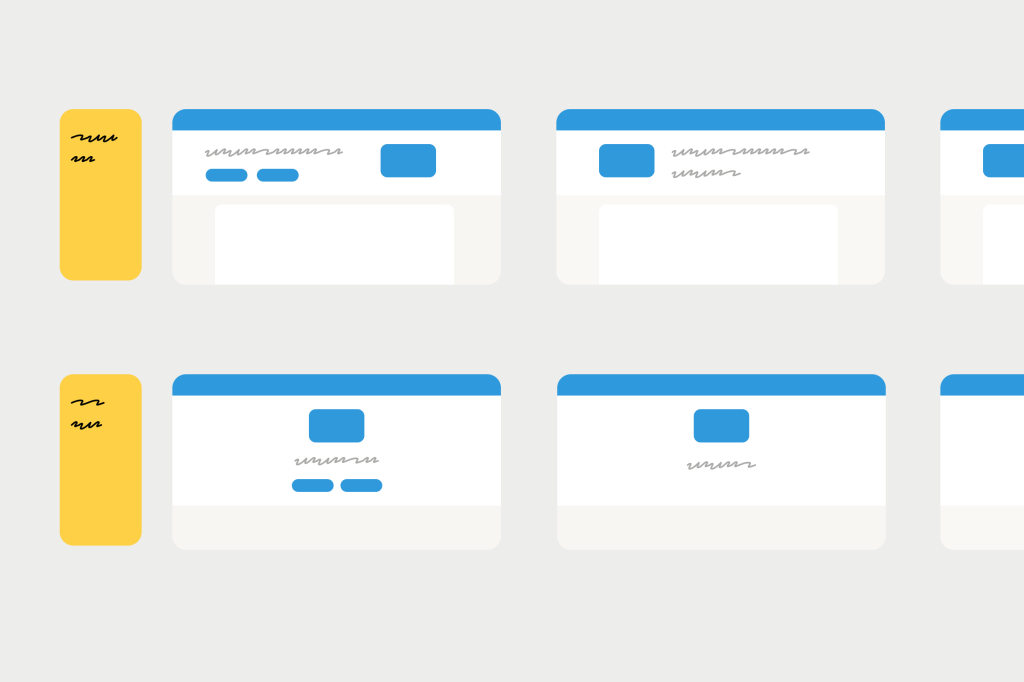
Each new approach is labelled (eg. “Full width panel). Variations or iterations related to it are also labelled and grouped together.
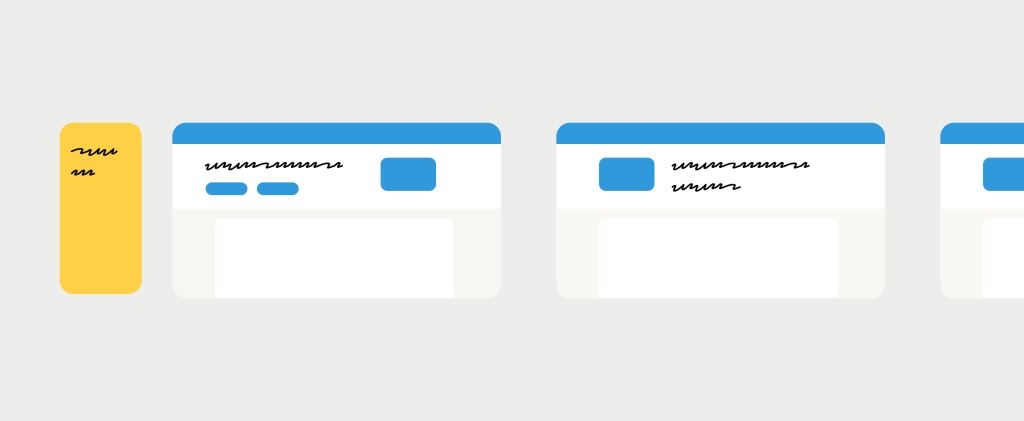
Then, when you’re ready, you create another direction and branch into related solutions from there.
Why this worked for me
At the time, I had started to work on product experiments, usually described as “growth design”. This meant I was thinking about smaller changes to workflows that could be built and tested rapidly.
Every solution also required a strong prediction or bet about how it would move a metric, expressed as something like “If we do X, then Y will happen, because X”.
Using this structure, I could organise my design file like a spreadsheet, with each hypothesis followed by a series of ideas. Once I felt I had exhausted that line of thinking, I moved onto a different hypothesis and another “row” of executions.
I remember reading about how designers at Spotify worked in a similar way. They called it “thoughtful execution”. Spotify designer Annina Koskinen explains why it’s important to explore multiple hypotheses (rows) and multiple executions (cells).
“Any problem or opportunity can be addressed in multiple different ways with varying results. That’s why it’s important to create multiple hypotheses per opportunity to see which one leads to the most desirable results. Each of the hypotheses can have several solution executions, so you can’t prove or disprove a hypothesis by just trying out one design solution.”
Aside from being a helpful way to organise and keep track of experiment solutions, I noticed a few other benefits:
1. More creativity
We have funny rules in our heads about what counts as creativity. For me, I thought I had to be kind of messy and impulsive to find these lightbulb moments. I don’t think that’s true. Sometimes a little more constraint can force us to think out of the box (like the repetition of crazy 8’s).
2. More buy-in
Working from goal to hypothesis to solution gave me a chain of reasoning that helped a lot when I was presenting work to stakeholders. It’s easier to gain consensus progressively, at each of these stages (a bit like going from lo-fi to hi-fi). It can be much harder to find agreement when we present a piece of work that has a lot of different ideas and assumptions baked into it.
3. More intentionality
By labelling screens with a “why” (hypothesis) or a “how” (execution), I’m forcing myself to ask:
- What’s actually different here?
- What problem am I trying to solve that the last one didn’t?
- What am I actually exploring here? What do I want to see?
That little pause and questioning can help prevent you from doing and re-doing the same thing over and over.
With a bit of structure in place, it makes it easier to work effectively with tools like Gemini. Gemini can help suggest new solutions for existing hypotheses or generate altogether new hypotheses you may not have thought of.
Putting it to work
In general, I’ve enjoyed less chaos in my Figma files while keeping (I think) my creativity intact. So if you’ve ever felt yourself spinning wheels, re-doing stuff, losing track of decisions, try out this method.
Most of us where I work at Xero are designing complex tools and workflows with lots of moving parts, and we don’t have the need to test different dimensions in this way. But if you’re designing more specific changes or in a high-traffic space like a check-out flow, designing a bit more like spreadsheet might work for you.
-
Is this co-design?

December 29, 2023 @ 7:01pm – Jiaoxi, Taiwan When we set out to co-design, we’re usually intending to get clear on a strategy or approach, find alignment across different groups and discover some new ideas together. If we’re putting together a formal workshop, we might plan, re-plan, create activities and facilitate the best we can.
And often these types of things work well. But the expectations don’t always match reality. Ideas can get a bit lost in translation. Some participants invariably feel left out, or misunderstood. And worse, the designer might end up creating something altogether different. It’s like the workshop never happened.
For some of those reasons, it’s natural for a designer to want to work in smaller groups, or by themselves, avoiding this way of working entirely. There’s less overhead and you can move faster if it’s just you and some focus time right? But less collaboration doesn’t work great either. Whenever I’m designing alone for too long or with limited input from other collaborators, I hit a dead end pretty quickly.
No one should design like this, even if it feels easier or more comfortable in the short term. I often think of this quote (now five years old) from Bob Baxley, reflecting on Apple’s review-heavy design culture: “If you ever found yourself sitting at your desk by yourself with your headphones on, stressing ’cause you felt like you had to figure it out on your own, something was really broken.”
Meet me halfway?
To make co-design more palatable, effective and integrated into our ways of working, we need something to fill that middle ground, somewhere between intensive multi-day workshops and flying solo.
Recently, I found myself in a cross-functional group that had formed to help with product growth. We wanted to test out a lot of little experiments and see if any helped customers to get onboarded and set-up faster. This shared goal had given us valuable alignment to begin with, but we still needed to decide what experiments to run and how they should work. We had limited time and a big backlog of experiments to flesh out. How were we going to work together?
Once or twice a week, we’d come together to ‘frame’ or ‘shape’ an experiment. We’d discuss the problem it would solve, risks and a few possible approaches. It was never longer than an hour, and it was purposefully unstructured. There might be some ideation or diagraming or maybe we’d spend most the session on the right problem to solve.
Initially, I found this working session really frustrating. I’d think, shouldn’t the designer be doing this? How can we start to design without exactly understanding the problem? There wasn’t any time to optimise or improve the activities. I had the typical fear (of designers) that we were rushing into solutions, and we were! But we also needed to agree (or disagree) and commit, so we could move onto the next experiment and keep moving.
But slowly, I started to see some benefits. When it came time for me to actually design something, I was no longer starting with a blank slate. Many of the edge cases that would have me spinning wheels had already been resolved. And design reviews were more effective, since everyone had shared context and had already contributed significantly to the concept. I didn’t feel like I was shouting down a one-way telephone line.
Why did it work?
I think this sort of framing activity worked well for us because:
- Everyone involved was responsible for driving the same goal
- We’d already prioritized the rough idea, so we could focus purely on the how rather than the why
- Each experiment was scoped to no more than two weeks to build, so there was a natural expectation for designing to be similarly fast

But most importantly, it succeeded because we allowed it to, without forcing it. If this was ‘co-design’, we never labelled it such. We need to allow co-designing to express in ways that are appropriate to your particular team or project. If you’re designing a new product from scratch, co-design will likely look very different. And that’s ok! It’s easy to get attached to how you think alignment and agreement should look. But if we’re too rigid in how we expect collaboration to happen, it probably won’t.

-
Subscribe
Subscribed
Have a WordPress.com account? Log in now.

