-
Finding gratitude in chaos
What should we do then? Make the best use of what is in our power, and treat the rest in accordance with its nature
Epictetus, Discourses, I, 1, 17Sometime in the 2010’s, gratitude had a moment. If you “systematically cultivated gratitude”, usually in a journal of some sort, the hope was to cool down your anxiety, become stress resilient, fill your heart with love and block toxic emotions like envy and regret.
On the 9th April, 2015, I caved in and bought a journal. Every morning, I would wake up and write down three things that I was grateful for. After about two weeks, you exhaust the typical stuff. Job, roof over my head, no crippling injuries or chronic conditions, working eyes. By week three or four, I found myself pondering a blank page. I guess I’m grateful for Tiramisu? Trains? Traffic cones?
Despite the mental blocks, I kept the practice up for a few years and I could always find something to jot down. And I never regretted being a bit more grateful.
Some time later, staring at the ocean (which I am immensely grateful for), I wondered ‘why gratitude?’ With all that scribbling, I never stopped to question why. I had definitely noticed positive effects on my mood and outlook, but why? Is it the emotion, the practice of writing every morning or something else?
All the small things
Firstly, let’s take a look at what the professionals are grateful for.
Tim Ferris suggested being grateful for the small things like the “convenience of a small notebook” or his “favorite yellow coffee mug”. “That trains you to notice the little things that ultimately translate to big things and not vice versa.”
Here’s what Tim was grateful for in June 2017:
- Bird song outside. Beautiful!
- Fireflies and stars last night.
- Rain outside to lull to sleep.
It makes sense to view a gratitude journal as a tool to notice things in your life. Maybe the journal makes you more present by encouraging you to consider and appreciate your immediate surroundings. If that’s the case, one might see similar benefits by sketching household objects.
Gratitude vs Fear
Tony Robbins is a very big man, and he is not interested in admiring that little coffee cup. He wants you to think big.
“Think of any other moment. It could be from your childhood or adulthood. It could be last week. It could be today. It could be ten years ago. Any moment that you could just truly feel like that was the greatest. That was magical. That was beautiful. That is magnificent. Something that gives you the feeling of tremendous gratitude if you really focused on it.”
For Tony, gratitude is more like an elixir, a powerful, cleansing spirit that you can pour into your mind. “The reason we use gratitude by the way, is the two emotions that mess us up most is anger and fear. You cannot be grateful and angry simultaneously.”
James Clear, author of Atomic Habits, agrees gratitude is like a smashing the positivity button.
“I am forced to think about the good in my life for at least a few seconds. The result is that there is not a day that goes by without me specifically stating something positive that is happening around me...You begin to realize that nearly everyday is a good day (at least in a small way).“
Wait a second. Positivity. Repetition. Isn’t that like the secret? Fuck!
Hacking Humans
From back posture to red dresses, interesting things can happen to our outlook on life when we focus our attention on something specific.
Scott Adams, creator of Dilbert, writes a goal 15 times a day, that “seems to work much of the time…but presumably not because of any magic.”
He thinks it’s all about focus. “At least one probable explanation for its perceived effectiveness is that focusing on goals changes the person who is doing the focusing… Affirmations probably also increases a person’s natural level of optimism, especially if you believe it works…To the extent that affirmations might increase a person’s stick-to-itiveness, his perception might be that the universe is removing barriers.“
The same applies to luck. Robert Wiseman, author of the Luck Factor, “learned that you can train people to expect luck, and cause an improvement in their ability to spot opportunities, that look like luck, when they pop up. “
Maybe I was training myself to ‘expect gratitude’ and in doing so improve my skill of noticing it in the every day. Whether or not my life feels better, what’s likely happening is my ‘eye for gratitude’ is getting keener.
Why I think gratitude works
Write down 50 unique, specific things in your life that you are grateful for. They could be objective (a small tree) to subjective (your favorite freckle). Done? Now look at that list. There’s one thing that ties them all together. And it’s got nothing to do with positivity or ‘smallness’.
Most things in our life, from our birthplace to how many chews of an apple you take before you swallow, are all largely out of your control.
To accept this fact, is incredibly hard. Buddhism says that not only are many things out of your control, but everything is changing all of the time. To remain equanimous in this broiling state of the present (good or bad) is something even the Stoics struggled with.
The present moment is chaos. The beauty of the right brain…the chaos makes it resilient, adaptable. I know I am in my right brain when I am feeling a sense of gratitude of anything at all.
Dr Jill Bolte TaylorGratitude, in this light, becomes a more palatable method to acknowledge and accept what you’ve got. Gratitude may really be a nice way to say “I notice many things are out of my control, and I’m okay with that.”
-
Relatively numb
The team gave thirty-four participants a test…jump on an exercise bike for fifteen minutes. They were told to pedal as they liked. The people who were good at perceiving their heart beats showed significantly smaller increases in heart rate and blood flow and covered a significantly shorter distance.
The two groups were matched for physical fitness. The only conclusion the researchers could draw was that those who can accurately sense the rate of their own heart beat are more sensitive to physical load: they feel the physiological pressures more, so they don’t push themselves as hard.
In contrast, the relatively numb bad-perceivers cycled fasters, because they felt it less. People who are good at heart-rate-sensing could therefore find it harder to get fit and build their fitness, because exercise is more off-putting.
Emma Young, Super Senses (2021)Interesting! Maybe those who are very disconnected from their heart beat could potentially approach exercise in a less realistic, more abstract way that may help you put up with it for longer and build a habit.

Shout out to the legend Bob Harper
I would also guess that someone obese or very unfit is likely not very sensitive to their heartbeat. I think losing weight and improving ‘cardio’ fitness will make you more sensitive to your own heartbeat.
-
Heart rate reliability
We know that genes alone contribute “more to sporting success than training, nutrition, coaching, tactics and any other interventions combined.”
So it’s really all about physiology. It’s common to see that the parents of pro cyclists were also successful endurance athletes of some kind.
We can assume everyone at the starting line of the Tour de France naturally possess high oxygen uptake, power-to-weight, peak-power and big hearts and arteries.
But when it comes to winning bike races, a lot of the analysis focuses on random stuff. Their character, their past performances, their likes and dislikes. “He’s very strong.” “He rides very offensively.” “He’s really thinks on his feet.” That sort of thing.
In the ATP (Association of Tennis professionals) there is an ‘Under Pressure Rating©‘ leaderboard calculated by adding the percentage of break points converted and saved, percentage of tie-breaks won and percentage of deciding sets won.
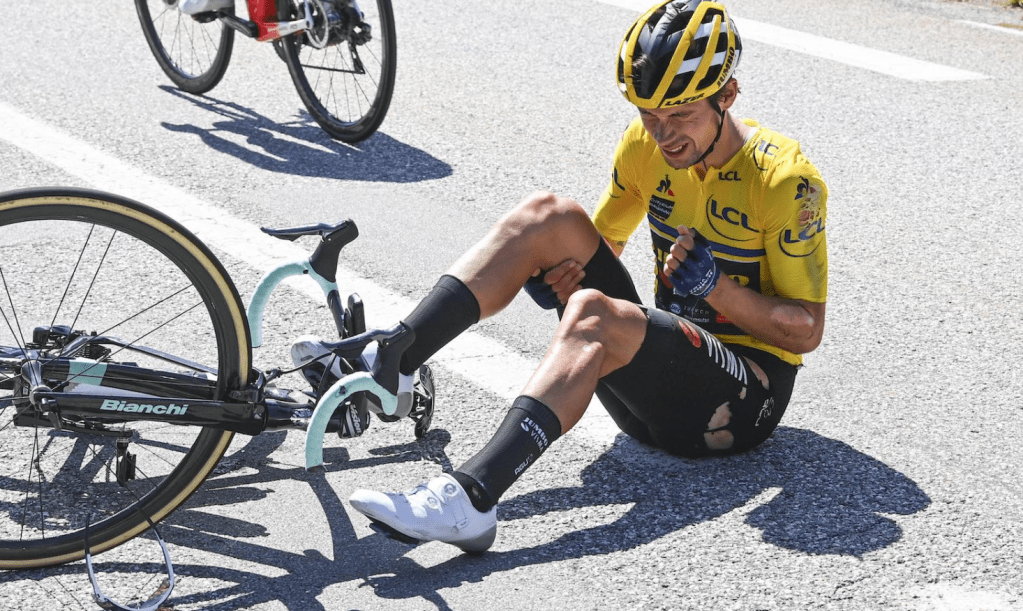
Photo: Cycling Tips
What would an ‘Under Pressure’ rating look like for a pro cyclist? Winning a Grand Tour by a few seconds takes a remarkable amount of physical and psychological strength, but here are a few other ideas:
- Stillness in the body
- Low number of crashes or near crashes. I’d be interested in how comfortable people look to be around this person in the peloton. For example, Roglic is an incredible cyclist but no one wants to ride behind him and he frequently crashes himself out of races.
- How often brakes are used (not including descending)
- Avg. descent speed
- Ability to hide pain (facial expressions)
- Ability to take off jacket, accept food, multi-tasking.
- Performance in wet
- Performance in chaotic races (eg. Roobaix)
- How often they do stupid stuff like take the wrong turn
- Accuracy of power output if they are riding to a target
Dylan Van Baarle, Tadej Pogacar Stefan Kung. The kind of guys you throw a banana at while they are descending at 100km/h and they’d laugh.
Notice I don’t mention anything about winning or peak power. Winning a race is function of many smaller behaviors and I’m interested in those little things adding up over months and years. This is also not about designing a ‘robotic’ cyclist, rather a clearer definition of a trustworthy/reliable cyclist.
Side note: These characteristics are probably more likely to be found in domestiques rather that star riders.
-
The inner game of Nick Kyrgios
“The (inner game) is the game that takes place in the mind of the player, and it is played against such obstacles as lapses in concentration, nervousness, self-doubt and self-condemnation. In short, it is played to overcome all habits of mind which inhibit excellence in performance.”
Timothy GallweyAt some point in 2021 I became a pro Tennis fan. Specifically, a Nick Kyrgios fan. Kyrgios turned pro in 2013, and as an Australian who wants to see a Grand Slam come home, I had already been rooting for him, despite all his yelling, bad sportsmanship and general disdain for the sport. But in 2021, watching him go ballistic against Thiem I saw something different. I was addicted!
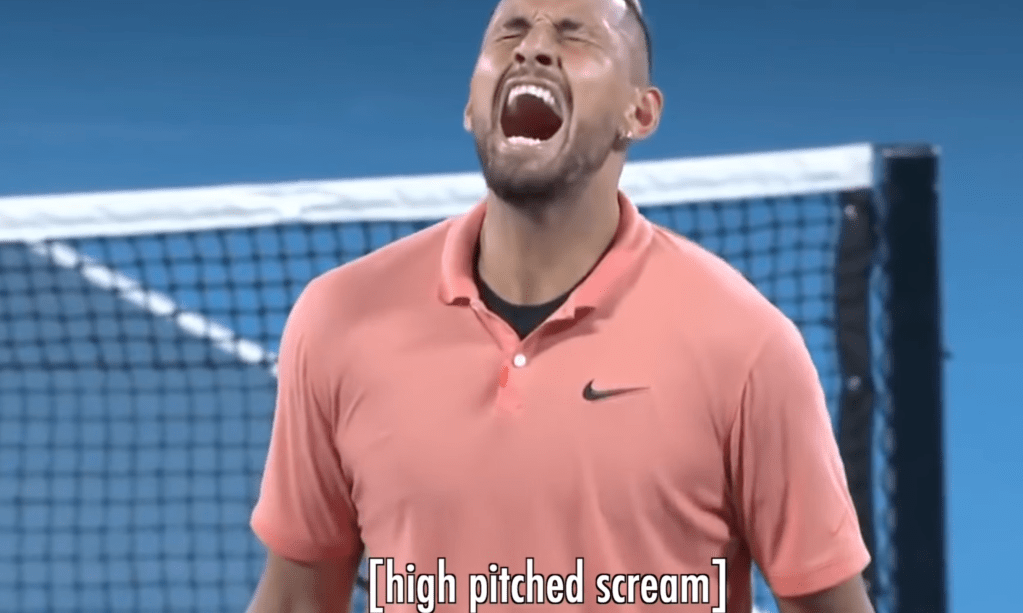
Hot (manufactured)
What makes him so interesting to watch? Why did I need him to win so badly? He usually flames out in early rounds, or maybe would make the quarters of a grand slam. After following him on a very good 2022, where he won the Doubles Grand Slam and several other tournaments, I have a few theories on what makes him tick and so fun to watch.
Firstly, let’s get the obvious out of the way. When a Nike scout discovered Kyrgios tooling around on some weedy grass court in Canberra he said “Unbelievable talent. Ridiculously fast arm. Out of shape. Big mouth.” This hasn’t changed. The variety, speed, flair, inventive-ness of his hitting makes the rest of the top 20 look like cyborgs.
But, like most tennis players, his biggest enemy is himself. Tennis is a very mental game, where you can’t afford to think too much and a small slip in concentration might mean game over. He doesn’t hide this fact.
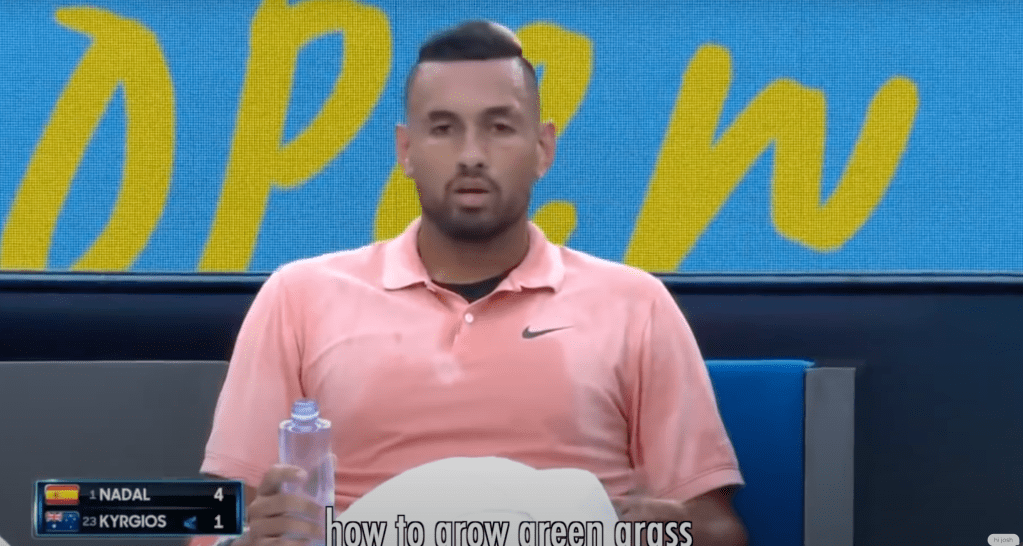
Cold (manufactured)
To deal with himself and his own mind, he has two simple tactics. Rage and ambivalence.
- Rage. Over some points or entire matches, Kyrgios goes thermonuclear. Sometimes this will get him kicked out of the arena. But also might deliver some of the most astonishing shots you’ll ever see. A game that comes to mind is the Wimbledon final. He could not serve any stronger or better, and Djokovic answers everything quietly and smugly. “WHAT DO I HAVE TO DO!!!!” Stay angry I guess.
- Ambivalence. The flip side to rage is the characteristic that is most identified with his public image, at least in Australia. He doesn’t care. He doesn’t try. He’s a waste. If only he applied himself. Look at the comments under any of his videos on YouTube to see people praying for him in this way. But I think like rage, this is a way to ‘switch off his brain’. When he doesn’t care, there’s no tenseness, no overthinking. Game that comes to mind is when he went ‘god mode’ playing Rublev in Miami. He looks bemused at the shame and anger that his opponent is stewing in. “He’s working like he’s got a reservation to get to.”
I think this can be frustrating for many of his fans, because he’s likely not consistent enough to win a slam, and even if he did, he would laugh – understanding the chaos he had to deal with between his ears.
-
The Courage to be disliked – Book review
The Courage to be Disliked is a popular Japanese book that “teaches us the simple yet profound lessons required to liberate our real selves and find lasting happiness.” Big claim.
I read this book in March 2019, and according to Goodreads, rated it 4 stars. I liked it, but nothing really clicked. Comrades, tasks, vertical relationships. What? The book plays out as a simple dialogue between young and old man, which was easy to read but I couldn’t connect with all these different terms. I tried, I put together a google slide deck, I sketched a bit, drew some diagrams, but otherwise forgot all about it.
Below, I’ve revisited some of the key themes that I think are important and how I think about them now. If you’re interested you should give it a read, you might get something out of it.
The past
Really? I thought the past makes you who you are? What about trauma? High school? Nope. Most of us ‘resolve’ and settle into a familiar track, whether that’s positive or negative. The tricky thing is you and only you need to make the decision to change your habits, which is hard because it’s easy to talk yourself out of such things.
Ego
The ‘courage to be disliked’ is really a fancy way of saying ‘liking yourself’. Instead, I interpreted this as ‘f*** the haters’, which is not quite the point. When it comes to relationships, we invent many judgements about others that are usually not true. Believing this type of thinking seems to cause great unhappiness.
In the book, the young guy is so adamant that his problems are important, intractable and unique. Our misfortune tends to feels very important and special, from a stubbed toe to a car crash. Humans are very good at fashioning these bubbles that become disconnected from reality. This view of the world applies directly to our relationships, where we obsesses over inferiority and endlessly compare.
Giving
The old man tells the young man to stop being such a special snowflake. If you can feel at ease with yourself, it’s completely natural to be interested and helpful to others. This is where a lot of feeling of goodwill, compassion and yep, the ‘h’ word comes from. There is no agenda. On the flipside, if you are angry and inward focused, it is easy to feel separate from others because, well that’s the way it feels! I believe this is a negative loop that can spin very fast and in some cases shoot you straight for intel-land . If we have a family member who is sick, we shouldn’t be concerned with anything aside from helping (not their response, complaints, side remarks, or any other thoughts you have about them) – because you love them, you’re physically able to and you feel good doing so.
Courage
Another idea I couldn’t connect up was ‘courage’. What does courage have to do with interpersonal relationships? The author encourages calm, objective self-worth and in a similar way that a large rock is ‘strong’, courage is something you get for free.
‘Seperation of tasks’
The chief task in life is simply this: to identify and separate matters so that I can say clearly to myself which are externals not under my control, and which have to do with the choices I actually control.
EpictetusLastly, in a similar way to how Stoicism ignored events out of our control, a ton of suffering emanates from general confusion and misappropriation of your attention and energy. If you feel some shame and embarrassment by a stranger who you interact with for 3 seconds, think deeply about what that says about you.
Rather than detached or ruminating, it’s possible to be bemused or stoic or equanimous. Like standing watching a stray dog chase its tail. Ultimately you have no skin in the game. Seperation of tasks was a confusing phrase but it’s simply understanding the fact that almost everything is somewhat out of your control. With that wisdom, it’s only natural to help others, create, give back, and maneuver through life with a little less friction.
-
‘Stick’, ‘Hole’, ‘Kangaroo’
I moved to Canberra in 2020 and started to ride more often. I encouraged myself to join a cycling group who rode around a few loops every Friday morning at 6am. It was actually a bit of a challenge. Even as the guy at the back, you have a few jobs. Look and listen for approaching cars from the rear, especially larger, faster cars. Most importantly, you need to study and focus on the wheel a few inches in front of yours. Stick to it. Glue to it. Don’t touch it. Don’t kiss it.
After a few rides I found myself at the front. When you sit at the front you take all the wind, and do a lot more ‘work’. That was fine with me. What was trickier was the focus. I had to focus. I had to shout out if there was a stick. I had to look for bad curbs, leaves, holes, cars, because I had a lot of guys behind me going 40km/h who need enough reaction time. A little less time thinking and more time looking. I would make some excuse and say I’m just nervous because I don’t know the route yet. If I knew the route off the top of my head, off by heart, or like the back of my hand, I could get back to thinking, rather than looking. I think the most likely time for someone to crash during a bike ride is likely when the front rider ‘rolls off’, allowing them to start thinking again.
These distractions can also be feelings. I feel nervous when a car speeds by behind me. But do I need to feel that nervous? Do I need to hold onto much anger for the driver who was going just a little too fast? If I’m that angry about stuff like that, it’s fair to say my mind is not on the road.
I also spent time learning to ride a track bike in the velodrome. Try daydreaming while your riding in a fixed gear with no brakes at 50km/h behind a motorbike!
Terminal velocity
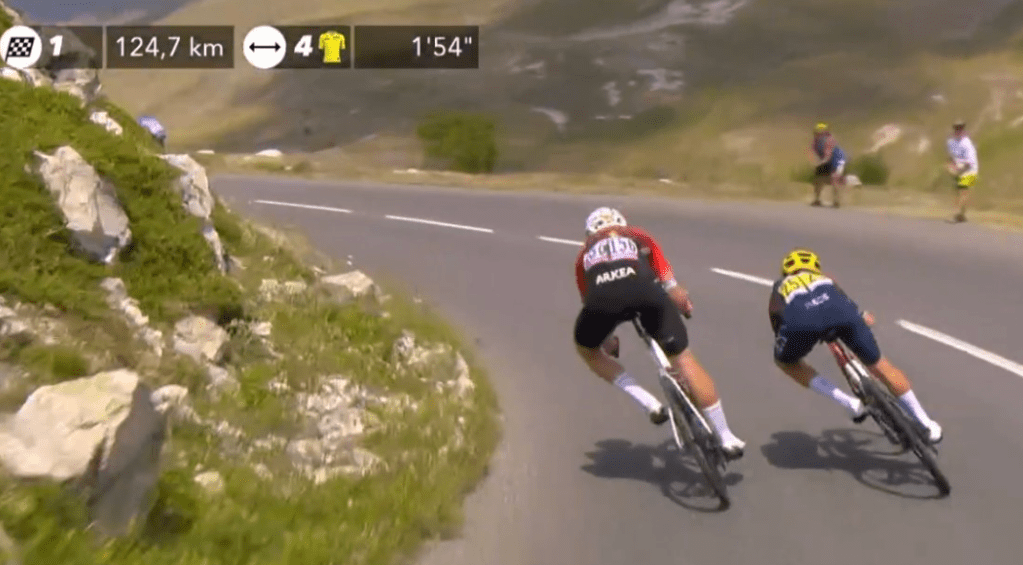
Tom Pidcock puts his brain on ice during his descent of Mt Ventoux.
“Consciousness deserts all processes where it can no longer be of use” William James, 1890
“Accelerate through the corners” – Grandpa
“I have no idea. I don’t know what my grip is called…It’s just all automatic. I don’t know how to explain it.” – Federer”
“I have my mind inside the pectoral muscles when I do my bench press.” – Arnold Schwarzenegger redefining the word meathead.
I’ve never been a great descender. My hands are gripped on the brakes. A few weeks ago, I crashed. I was taking a tight right turn and I slipped on the road. I was conscious of moving too quickly to the edge, feeling scared and out of control. I couldn’t move my bike. Brakes are a useful invention, but I was likely relying on them heavily as a crutch. Are you using your brakes to come to a controlled stop, or are they a bit more automatic? Have you simply built up too much speed?
A pro cyclist on the other hand, has spent years training themselves to become one with the bike. Lance’s bike position looks like he has started melding his fingers with the bars. They put their faith in the machine, the road, their skills and go with the flow. When the descend, brakes are rarely on the agenda, more like an insurance policy or a killswitch. They are physically and mentally at ease with letting their bike reach something close to terminal velocity.

Tadej Pogacar is furious with his brakes locking up, because now he’s forced to think about something he shouldn’t need to.
If you are able to focus, you should see a reduction in judgements (both good and bad) and errors on the bike.
-
Riding without a chain
Armstrong called it a “no chain” day – meaning he felt so strong that it seemed as if his bicycle had no chain.
Before cycling I did CrossFit. I enjoyed the variety, learning the technical olympic lifts and the social aspects of ‘the Box’. But what got me coming back every week, sometimes trudging through the snow in sneakers and shorts was the ‘WOD’ (Workout of the Day). 15 minutes at the end of class: fast and intense and filled with suffering. At the start of the class we’d peer at the WOD that would be coming in 50 minutes. “Oh fuck, it’s ‘Helen‘, I hate pull-ups.” I loved them. I told myself I hated it and it was a chore, but it was something else. They gave me a measurable and simple way to sit with pain, discomfort, fear, stress. If I gritted my teeth and went balls to the wall, I could get some results on the board. But that was as much as I thought about it. WODs are hard, but I keep doing them.
Once I started riding my bike more regularly, I was drawn to climbs. Which makes no sense really. I’m tall and heavy (90kg). Even if you’re pure muscle, cycling does not have time for weight. I used to watch old clips of Armstrong (doping aside) as a sort of inspirational figure to get me up those hills.
In every different city I’ve lived in for the past few years, I’ve made a certain hill my enemy. I don’t always ride a bike this way, offensively, but on occasion I decide that what I need is a full on assault. I’m going to war. In Canberra, it was Mt Ainslie, a sharp, mean-spirited 1600m at 10.4%. I grew to love the climb and the challenge that left me feeling like I was seconds away from calling an ambulance. When I moved to San Francisco, which is a city of hills, I didn’t have a particular enemy but instead chose to fight all 20 of the steepest.
I felt like Crossfit had massively improved my strength and cardio, and I was a strong cyclist, but perhaps the transfer was more about discomfort than anything to do with muscles.
-
Subscribe
Subscribed
Have a WordPress.com account? Log in now.

