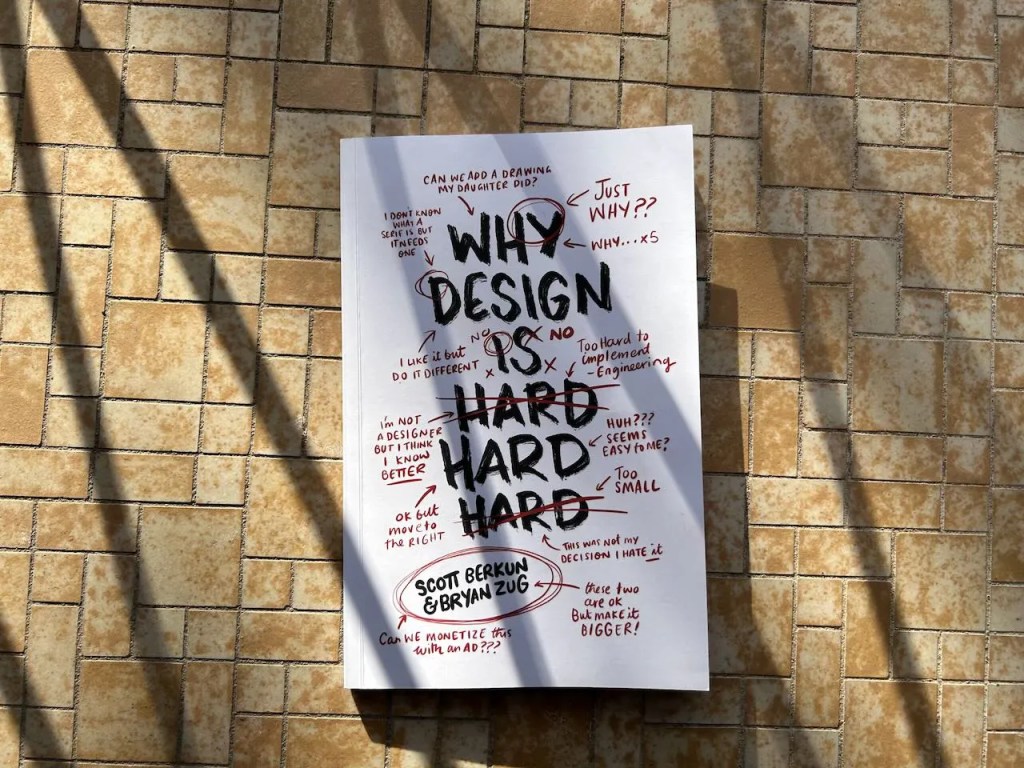
These days, whether it’s gen AI or the overall death of the industry, there’s no shortage of problems flying around for designers. And that’s what I expected to read about when I picked up this short book titled Why Design is Hard.
But instead, I was surprised to see the argument made that design is hard because of an internal problem, rather than an external one; that the profession of design has flaws in how we think about what we do.1
So why is design hard?
- Designers tend to think of design as a solo activity, when it’s clearly not
- Designers tend to think others should just trust their design decisions
- Designers tend to overvalue creativity over bottom-line value for the business
The authors suggest that this type of attitude lands designers (of all levels) in all sorts of trouble. Designers are then surprised when priorities change, offended by constructive critique or resentful that their skills are undervalued or misused.
With a bit of a reality check, designers can stop tripping over themselves and basically get back to designing.
This made me wonder, does every profession struggle with these sorts of attitude problems, or is it only design? Maybe because UX design is a relatively new profession (~100k UX designers in the U.S), it never had much time to solidify its identity, and maybe never will.
The latter half of the book shares a few ideas for ways of working more effectively, particularly focused on designers within large organizations. Here are three that stood out to me:
If you can’t sell it, did you even design it?
In order for your precious work to see the light of day, a designer needs to not only deliver well designed solutions but articulate how the design solves it in a way that is compelling and fosters agreement.2 Like a politician running for election, what’s almost equally important to their ideas is how those ideas are communicated to the voters. For designers, whether it’s explaining a problem, or the results of a successful experiment, if your communication isn’t clear, it’s like it never happened.
The system is working (just not for you)
Have you ever been really surprised by something, like a project that was cancelled at the last minute, or user behavior that clashed with the data? It turns out that often what can seem like stupidity is often a constraint you can’t see.3 Rather than reacting blindly, or waiting for the perfect internal process to materialize, designers should learn to use system thinking (eg. 5 Whys) to help us understand our environment better and anticipate future hiccups.
The one thing designers forget to do…
Let’s face it. No one ever says ‘involve me as late as possible.’4 Whether you are an engineer, or product marketer, a lack of trust and collaboration with design is a recipe for disaster. That’s why it’s critical for designers to shepherd the work through the organization5 and lead their core team along the design process. In a way, showing the same care for coworkers as you might for the end-users you design for. Again, I think soft skills like active listening, empathy & communication do most the heavy lifting here.
Overall, Why Design Is Hard is a short, slightly bitter perspective on how to be effective as a designer (especially within a large organization).
Thankfully, there’s not too many grand proclamations or predictions on the future of design, just good advice on how to stop getting in your own way.
- Why Design Is Hard by Scott Berkun and Bryan Zug ↩︎
- Why Design Is Hard by Scott Berkun and Bryan Zug ↩︎
- Why Design Is Hard by Scott Berkun and Bryan Zug ↩︎
- Why Design Is Hard by Scott Berkun and Bryan Zug ↩︎
- Why Design Is Hard by Scott Berkun and Bryan Zug ↩︎

 Buddha Bike