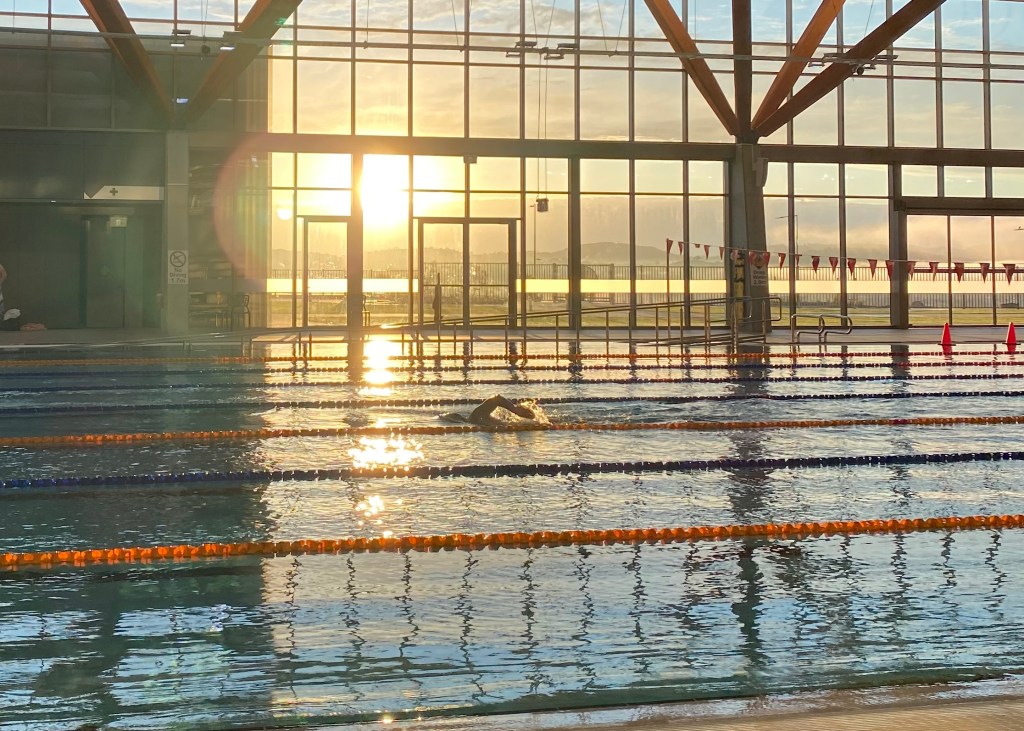
I’m lap swimming, like I usually do on a Monday evening. It’s a coached squad and there are six or seven others in my lane. We’re meant to swim about five seconds apart, but we tend to bunch closer, so the person in front is almost kicking in your face. Swimming that close gives you a bit of a ‘draft’ and uses less energy.
We order ourselves fastest to slowest, which generally works well. I’m usually the second slowest. If I miss a few weeks or have an off-day, I’m dead last. When we’re asked to swim “fast,” I only need to keep in touch with the person just ahead of me, someone slightly quicker. If I were near the front, I simply couldn’t keep up.
And that’s exactly what I found myself struggling with. We were meant to be swimming at a moderate pace, but I noticed a gap opening between me and the swimmer ahead. “What’s going on?” I wondered, kicking harder and pulling faster. “Am I slow? Or are they extra fast tonight?”
Over the next few laps, I worked to close the gap, eventually bringing it down to a body length. I felt satisfied, but I was gassed. In trying to keep up, I’d been swimming much harder than the coach had asked. It wasn’t sustainable. Luckily, the set ended, and I could rest for a few minutes before we started again.
I think one of the main reasons I strain to keep up is because I hate the feeling of being passed, or of slowing someone down behind me. It’s the same pressured tension you might have felt when rushing to an appointment, gripping the steering wheel as traffic refuses to move
Before that moment, I’d never really admitted that to myself. I’m far more likely to get irritated, blame others, vow to get fitter, or just swim harder. Anything rather than really acknowledge that bad feeling.
Sometimes I’ll move to the very back, so there’s no one behind me. Back there, there’s no pressure, no fear of blocking anyone. But usually someone’s already claimed that spot. There’s usually a swimmer nursing some kind of sore shoulder or something who insists, “No, you’re faster than me, stay where you are” or “where do you think you’re going?” And so I’m back where I started. Burning with indignation, trying to keep up with the person in front while the swimmer behind is on my heels (literally). So much for that shoulder.
Another way to avoid being passed is to just give up and get out. This isn’t usually my style, but I do see this in my lane all the time. A swimmer is up near the front, swimming strongly for three-quarters of the set, then suddenly veers off to the side, clutching a calf or hamstring in mock agony. A cramp, exhaustion, hunger or a multitude of other excuses can become a get-out-of-the-pool-free card. With a laugh or a shrug, they no longer have to worry about keeping up.
Luckily, there’s a simple antidote. Just let yourself get passed! Relax. But you’ve really got to let it happen. No excuses. Swim the best you can, and if someone passes you, you got passed, simple as that. Remind yourself that no one has asked you to not get passed, except yourself. Obviously, it’s not going to feel good, but that’s sort of the point.
Exposure always helps, but there’s deeper assumptions to fight if we want to avoid this reaction for good.
Falling behind and keeping up both assume there’s a race, a specific result that’s expected.
But that goal line doesn’t exist. The pressure is entirely self-created.
When we see that clearly, the straining and the avoiding are no longer needed.
 Buddha Bike
2 responses to “Swimming under pressure”
[…] writing: Partly cloudy, Swimming under pressure, Inner Game of Nick […]
LikeLike
[…] Swimming under pressure – If there’s no race, there’s no need to keep up […]
LikeLike