“If you come across any special trait of meanness or stupidity… you must be careful not to let it annoy or distress you, but to look upon it merely as an addition to your knowledge – a new fact to be considered in studying the character of humanity.” – Schopenhauer
“The kind of attention we bring to bear on the world changes the nature of the world we attend to.” – Iain McGhilchrist.
“I would permit no man, no matter what his color might be, to narrow and degrade my soul by making me hate him.” – Booker T. Washington
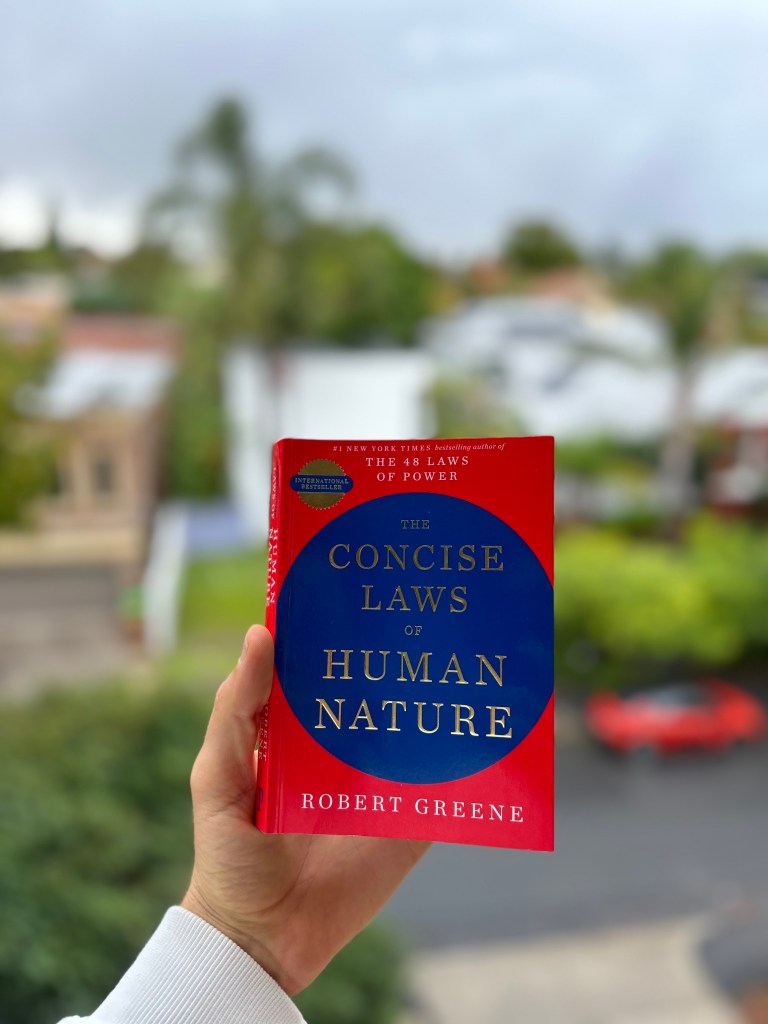
The book: The Concise Laws of Human Nature – Robert Greene (2018)
Date read: Feb 20 – 21, 2024
To Robert Greene, studying human nature does not have much to do with genetics, evolution, chemistry or physics. Instead, we’re looking into all the soft, squishy, smelly stuff that flames in the trash-can of the ego. Our egos get us into trouble again and again. They’re brazen, fragile, hostile, fickle, competitive, self-confident and ultimately disconnected from reality. The ego sees threats that aren’t there and projects a cloud of fantasy over real people and relationships, leaving us lonely, unsatisfied and suffering.
Greene attacks the subject of human nature as a systemizer, and this heavily structured almost synthetic style of writing grates on me (even in the concise version). He’s a wide reader (like his protege Ryan Holiday), and there’s dozens of insights and anecdotes squeezed into the tiny pages. But overall I didn’t like the tilt toward deception, persuasion and competition. But that’s to do with his audience. He’s writing for ambitious teens, freshman, businessman, those trying to understand the ego for their own advantage.
Although he doesn’t write directly about it, I think the most big idea of this book is the importance of how we use our attention. Our relationship to life, death, friends, lovers, bosses can all be negatively distorted and skewed if we don’t have a good grip on our perception of those things.
Here are five other ideas about human nature:
- People exist: Greene suggests to “see other people as phenomena, as neutral as comets or plants. They simply exist. Work with what they give you, instead of resisting and trying to change them… It is all part of the human comedy.” Rather than judging people or desperately want them to change, we should work with what we’ve got, or what’s presented to us.
- Face your dislikes: Psychologically, we are big stinking bundles of habits and memories. To grow, change and get things done, we’ll need to do things in new and different ways. To break some of our bad habits Greene suggests “to not react in the moment by repeated placing yourself in stressful or adverse situations in order to get used to them.” It’s not just about cold water shocks and facing your deepest fears; we need to stop distracting ourselves in even the must mundane situations. “In boring everyday tasks you cultivate greater patience and attention to detail.”
- Don’t seek, settle: Desire is a big motivating force in our lives, but can also backfire when we keep trying to seek the unattainable. Take a romantic relationship as example. “There is nobody perfect. Instead, it is better to come to terms with the flaws of the other person and accept them or even find some charm in their weakness.” By calming down “covetous desires”, we can learn to compromise, be at ease in the world and stop ourselves from constantly getting drawn away from reality. Greene also makes a great point that constantly seeking perfection in our work or love life burns a tremendous amount of time and energy, two precious and finite resources.
- Confirm, don’t critique: People don’t want the truth. I’m often asked by other collegeues for feedback or advice on their projects. I try and help them like I would help myself, and make sure I don’t come across as too direct (which is more my natural style). I try and be objective and explain how to improve their work. But I was surprised by Greene’s suggestion that most people “do not want the truth; they want support and confirmation given as realistically as possible.” Part of me recoils against this advice. Why even come to me in the first place if I’m just going to pat you on the back? But I see the point. This isn’t an either/or type of thing. Just because they are working toward a goal doesn’t negate the need to steady nerves, build confidence and get reassurance. It makes me realize most of the time I show my work I’m also looking for some amount of confidence boost too.
- You’ve got more energy than you think. A friend at work was complaining how ‘low energy’ she has become recently. She had seen several different kinds of doctors, and complained about a number of negative factors in her life. Her energy had disappeared. Or had it? At the end of the day I saw her showing someone around a social gathering, and she was smiling and brimming with renewed focus and excitement. You might say this was to do with a change in chemistry, or her preference for extroversion, but there was no doubt she had found a huge reservoir of energy out of nowhere. Where had that come from? It’s likely that we have and can access more “wellsprings of energy and health” than we think we can.
 Buddha Bike