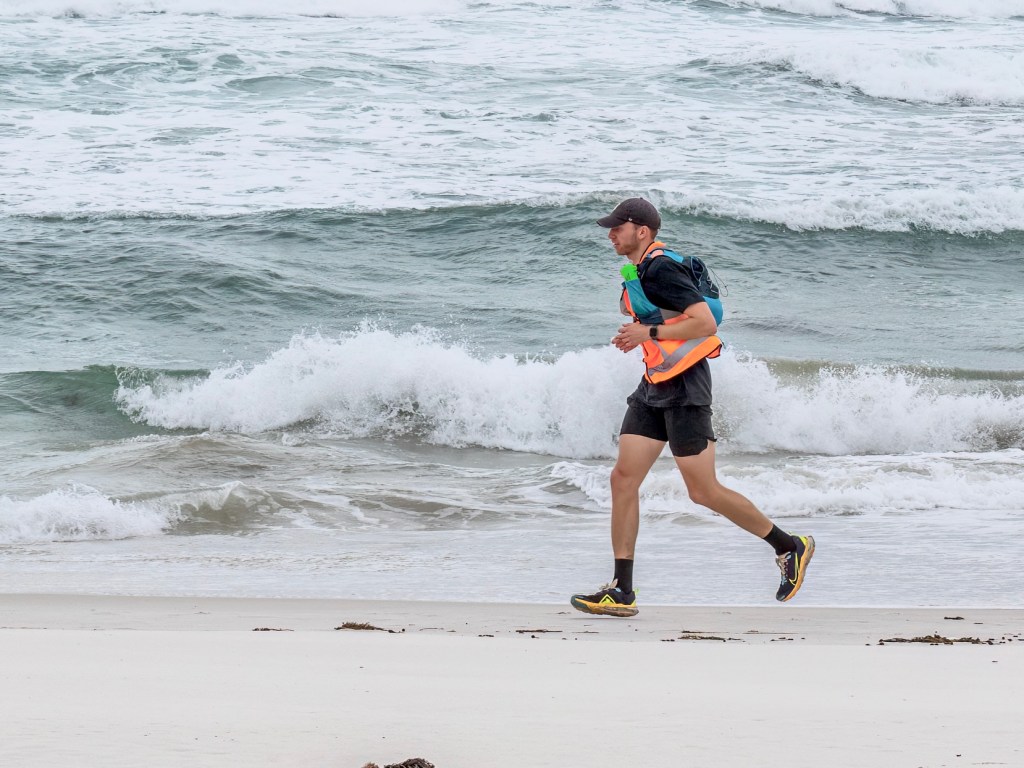
Ever since I read Born to Run by Christopher McDougall I’ve been thinking about it. I’ve also been running. Most of the time, I’ve run along the river near my home, but also around closed city circuits with thousands of people and on pristine beaches in the middle of nowhere.
There’s a Chinese proverb that describes four basic postures of human activity. Walking, sitting, lying and standing. As for exercise, running feels a bit like the fifth posture. We know how to do it when we are kids, it requires little to no equipment and there’s no rules or regulations attached. Just run. It’s also natural. It’s a bit of primal behavior that can easily be woven into your week. Like gardening or camping, running serves a valuable function of connecting us to a simpler, uncomplicated world before alarm clocks and spreadsheets and ‘X’.
I agree with McDougall that we’re all natural born runners, but what does that look like?
Listening to your feet
She judged her speed by the tickle of wind on her skin.
Born to Run
The kids accelerated when they felt frisky, downshifted when they didn’t, and caught an occasional breather under a shady tree.
Born to Run
Your body is an intelligent, finely tuned instrument. And your feet are no exception. Unfortunately, we tend to forget they exist. We plug our ears with loud music and forget all about the two very sensitive organs attached to the bottom of each leg. Instead, we tend to focus on the workout or the latest sports science approved technique. Ignoring, battling or overriding natural signals from our bodies is a sure way to run yourself into the ground.
Turning down the throttle is also a tried and trusted way to maintain and persevere your energy as you run. It’s like squeezing a tube of toothpaste. If you squeeze desperately and mindlessly, you’ll get a spurt of it and have to readjust to get the rest. If you are careful and watch what you’re doing, you’ll be able to get it all out in one go. Energy is always a finite resource, but if managed right you won’t run out of it as quickly.
Chasing antelope
50,000 years ago, a hunter would chase an antelope on feet. Their attention would be mainly focused on their target, but also on their bodies; their thirst and that sore left ankle that was playing up again. They would also need to be aware of their surroundings. All animals from sea anemones to giraffes need to have these two different ways of looking at the world. Iain McGilchrist explains that if an animal is “only paying one type of attention, it will not survive because it will become prey to another creature very quickly. It needs to have a different attention, which is broad, open and sustained.”
Generally, we suck at that second kind of attention. But it can be helpful and pretty easy to practice while running. A simple way to do this would be to try and check in with what’s above your head. You don’t need to look, or think about it. Just check in. Get a sense of how far above your head branches are hanging. Are they close? Or is there sky? Are there noises up there? What kind? It’s easy. Your body is very good at this.
Take advantage, give up control
Take what comes to you and take the advantages out of it rather than resisting it and trying to make it into something it isn’t.
Iain McGilchrist
A man never rises higher than when he does not know where his road will take him.
Nietzsche
Never know when it will end. You can’t control it. You can only adjust.
Born to Run
I’ll admit it. I track my runs with an Apple Watch. I even glance at it from time to time. But although I find stats like distance or duration helpful, anytime I’ve properly dug into the data (and at this point I’ve got a lot of it), I can’t say I’ve ever been struck by an insight that’s improved or even changed the way I run.
If you’re looking to run further, faster and have more fun doing it, I’d focus on mental flexibility rather than more technology. No matter how good your computer is, it’s not going to prevent a bad mood, a wave of fatigue, a flash of rain or a pothole where you least expect it.
Technology can plan every turn of your route, keep your heart rate beating like a drum machine and shave seconds of your PB. It extends human control, and a little bit of control is fine. But it doesn’t have all the answers. It’s better to embrace the chaos and uniqueness of every run rather than fighting against it.
 Buddha Bike