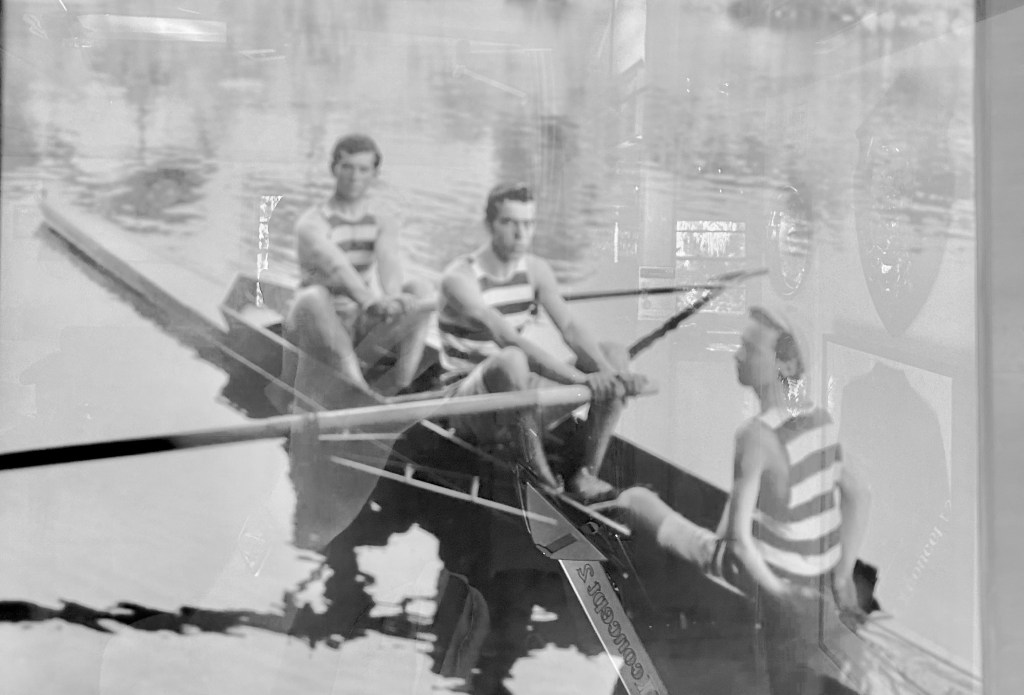
Sensing types are not up in the clouds. Their feet are planted firmly on the ground. They like to get their hands dirty. Talk shop. Sensing types are found in a rugby scrum, behind a bar at a busy restaurant, planting trees in a garden or walking the streets with a nightstick. The Swiss countryside is filled with hearty, earthy sensing-type farmers.
I’m not a sensing type of guy. In fact, it’s likely my weakest cognitive function (how we prefer to interact with the world.)
Swimming laps is something I love to do, but also helps me to get in touch with my immediate surroundings and dial up my sensing. But as an introvert, it’s always easy to retreat when things get tough. You can give up and finish up practice early. You can waste 50 laps lost in thought, with no real repercussion. And although I usually train in groups, these are all ultimately individual pursuits. Recently, I’ve tried out rowing, which is another activity that sensing types love to do. But unlike swimming, cycling and running…
Rowing doesn’t let you hide.
Being present isn’t a nice to have when you’re rowing, it’s compulsory. When you’re rigging the boats, all the details matter. Order, size, colour, space matters. If I take a step out of place, I’m knocking over oars or damaging a hull. I’ve got to listen and look around me constantly. Once you’re on the water, you need to concentrate and row in rhythm with the other guys in the boat. Sensing types love this sort of thing. It’s concrete, practical and when everything fits together, there’s a beauty to it.
But for me, my mind is going absolutely berserk, looking for an excuse or an exit out of there. Doubt, fear, confusion and endless criticism make it uncomfortable to get in the flow. Rowing shines a very bright light on these habits with an exhausting amount of feedback loops:
- Stability in the boat is important. If one oar lifts up too high, the boat is immediately off balance.
- The tenser my body is, the harder I grip the oars. The harder I grip, the harder it is to square the blades, and the more my hands get blistered.
- What matters most is probably keeping in time with the stroke. The feedback for a lapse in concentration is a horrible clang of oar on oar.
- We think that negative thoughts help us to improve, but any thinking at all tends to take you off track. Paradoxically, the thought focus on the stroke takes you out of rhythm.
For brief moments, we find some peace. There’s some encouragement over the loudspeaker. ‘That’s good. More like that.’ You are surprised to find that you are both relaxed and concentrated. You’re not smiling and serene but you’re not frustrated either, you’re in the middle. You’ve forgotten about the time, but you’ve recognized for a brief moment that you really are sitting in a boat on a river.
 Buddha Bike
One response to “Nowhere to hide”
[…] Nowhere to Hide – Rowing demands a lot from someone who is not a practical ‘sensing’ type. […]
LikeLike